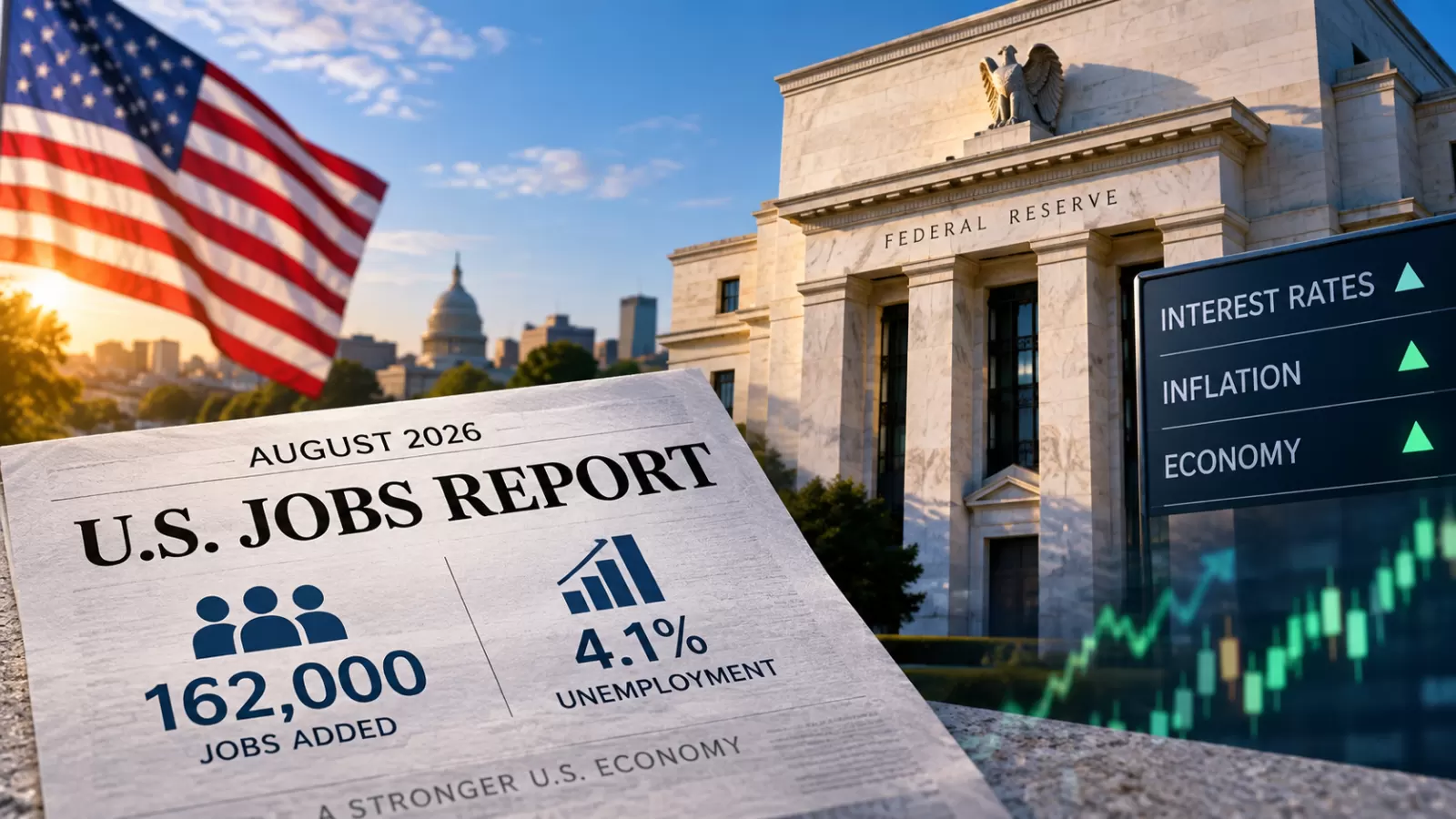
The August jobs report 2026 delivered a major upside surprise Friday, showing that U.S. employers added 162,000 jobs while the unemployment rate remained unchanged at 4.1%.
The stronger-than-expected hiring numbers immediately put the Federal Reserve back in focus, as investors weighed whether a resilient labor market could give policymakers more room to raise interest rates as they continue their fight against inflation.
According to the U.S. Bureau of Labor Statistics, total nonfarm payroll employment increased by 162,000 in August, a sharp acceleration from the previous month.
The report also provided a more encouraging picture of recent hiring than previously thought. July payroll growth was revised to a gain of 21,000 jobs, while revisions to June and July combined added 55,000 jobs to previous estimates.
For Americans watching the economy, borrowing costs and financial markets, Friday’s report matters for a simple reason: the labor market appears considerably more resilient than many economists had expected.
August Jobs Report 2026 Beats Expectations
The headline number was the biggest surprise.
U.S. employers added 162,000 jobs in August, substantially exceeding economists’ expectations.
A Reuters survey of economists had projected an increase of roughly 56,000 jobs. The actual result came in nearly three times higher.
At the same time, the unemployment rate remained at 4.1%.
The labor force participation rate — the percentage of working-age Americans who are either employed or actively looking for work — increased to 61.6%.
Together, those figures suggest that the U.S. labor market entered the final months of 2026 on firmer footing than recent employment data had suggested.
The numbers are particularly significant after July’s initial report raised concerns about weakening hiring.
Those concerns have not disappeared completely, but the August rebound changes the picture considerably.
For more coverage of developments affecting companies, consumers and financial markets, visit BriefTop Business.
Which Industries Added the Most Jobs?
The August jobs report also revealed where much of the hiring occurred.
Employment increased notably in food services and drinking places, which added 59,000 jobs during the month.
Local government education added another 42,000 positions.
Those gains helped drive the overall increase in payroll employment.
Not every part of the economy moved in the same direction, however. The information sector lost jobs during August, according to the BLS.
The uneven performance is a reminder that a strong headline employment number does not necessarily mean every industry is experiencing the same conditions.
Some businesses continue to face pressure from higher costs, changing consumer demand, technological disruption and uncertainty surrounding the broader economy.
Why the Jobs Report Matters for the Federal Reserve
The Federal Reserve is one of the biggest reasons Wall Street pays such close attention to the monthly jobs report.
The Fed has two major economic objectives: maintaining maximum employment and keeping prices stable.
A rapidly deteriorating labor market can give policymakers a reason to lower interest rates to support economic activity.
A strong labor market, however, can give the central bank more flexibility to keep monetary policy restrictive — or potentially raise rates — when inflation remains a concern.
That is why Friday’s unexpectedly strong employment report quickly changed the conversation around the Fed’s September meeting.
Reuters reported that market expectations for a September interest-rate increase rose sharply following the jobs data.
The Federal Reserve’s next policy decision is scheduled for September 16.
But the August jobs report will not be the final major piece of economic information policymakers receive before making that decision.
Inflation Could Be the Next Big Test
The next major event for markets comes on September 11, when the Bureau of Labor Statistics is scheduled to release the August Consumer Price Index.
The CPI is one of the most closely watched measures of inflation in the United States.
That report could be especially important this month because strong employment gives the Federal Reserve less reason to focus on supporting the labor market.
If inflation also comes in hotter than expected, investors could see an even stronger case for tighter monetary policy.
If inflation cools significantly, however, policymakers may have more room to remain patient despite August’s strong hiring numbers.
In other words, the August jobs report answered one major question about the U.S. economy but immediately made the upcoming inflation report even more important.
Wall Street Reacts to Stronger Hiring
Financial markets reacted quickly Friday morning.
Stocks moved lower while Treasury yields rose as investors reassessed the outlook for interest rates.
According to Associated Press, the S&P 500 fell around 0.5% during morning trading, while the Dow Jones Industrial Average was down roughly 0.7%.
The Nasdaq Composite was also lower.
Bond yields moved higher as traders adjusted expectations for Federal Reserve policy.
The reaction may seem counterintuitive: more jobs are normally good news for the economy.
But financial markets often interpret economic data through the lens of what it could mean for interest rates.
When hiring is unexpectedly strong while inflation remains elevated, investors can become concerned that the Federal Reserve will keep borrowing costs higher for longer.
That can affect stock valuations, Treasury bonds, mortgages and other forms of credit.
What Could a Fed Rate Hike Mean for Consumers?
The Federal Reserve does not directly determine the interest rate on every mortgage, credit card or auto loan.
Its decisions can nevertheless influence borrowing costs throughout the economy.
If policymakers ultimately decide that another rate increase is necessary, consumers could continue facing elevated financing costs.
Credit card borrowers are particularly sensitive to changes in interest rates because many cards carry variable rates.
Prospective homebuyers also closely watch monetary policy because expectations surrounding Fed decisions can influence Treasury yields and, indirectly, mortgage rates.
Businesses face similar pressures.
Higher borrowing costs can make it more expensive to finance expansion, purchase equipment or invest in new projects.
That is one reason the August jobs report has implications well beyond people currently looking for work.
Is the U.S. Labor Market Getting Stronger?
One month of data cannot establish a long-term trend.
However, several elements of the August report were encouraging.
Payroll growth accelerated substantially, unemployment remained at 4.1%, labor force participation increased and previous employment estimates were revised upward.
At the same time, wage growth remains another important part of the picture.
Average hourly earnings were up 3.1% from a year earlier, according to the August employment data.
For the Federal Reserve, the challenge is determining whether the economy can maintain healthy employment without generating renewed inflation pressure.
For workers, the situation is more complicated.
A low unemployment rate is generally positive, but the availability of jobs, wage growth and the cost of living ultimately determine how households experience the economy.
What Happens After the August Jobs Report?
Attention now shifts from employment to inflation.
The August CPI report scheduled for September 11 could play a major role in shaping expectations before Federal Reserve officials conclude their two-day policy meeting on September 16.
If inflation remains stubbornly high, the combination of persistent price pressures and stronger-than-expected hiring could strengthen arguments for another rate increase.
If inflation shows meaningful improvement, policymakers could instead decide that the current level of interest rates is sufficient.
Either way, the August jobs report 2026 has changed the economic conversation.
The U.S. labor market entered September with more momentum than economists expected, and that resilience could now become an important factor in one of the Federal Reserve’s most closely watched decisions of the year.