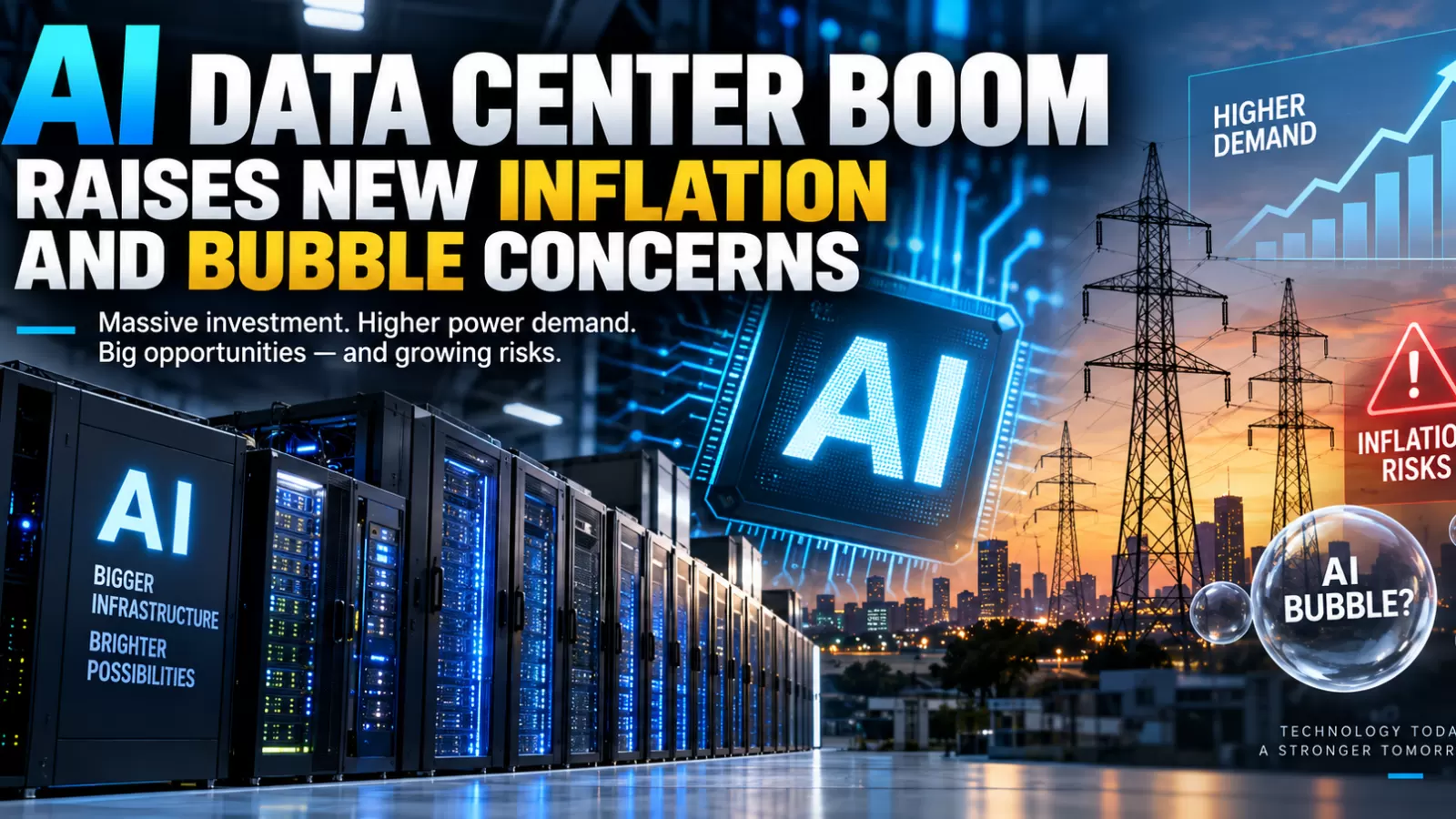
Artificial intelligence is transforming the technology industry, but the enormous infrastructure required to power it is beginning to create another economic question:
Could the AI boom itself contribute to inflation?
Technology companies are spending enormous amounts of money building data centers, buying advanced chips, securing electricity supplies and expanding computing capacity.
That investment could eventually deliver major productivity improvements.
But central bankers and economists are increasingly examining what happens before those benefits arrive.
On September 22, Reserve Bank of Australia Governor Michele Bullock said the current AI investment boom is already increasing demand in the economy while clear supply-side productivity improvements remain difficult to see, according to ABC News Australia.
Her comments add to a growing debate about the economic consequences of the global race to build AI infrastructure.
AI Is Creating Huge Demand Before Productivity Arrives
The long-term economic argument for artificial intelligence is relatively straightforward.
If AI allows workers and companies to accomplish more in less time, productivity could increase.
Higher productivity can allow economies to grow faster without necessarily producing the same inflationary pressures.
The problem is timing.
Before AI can generate those gains at scale, companies first have to build the infrastructure necessary to run it.
That requires:
- Construction
- Electricity
- Semiconductors
- Land
- Cooling equipment
- Networking hardware
- Engineers
- Enormous amounts of capital
Speaking on Tuesday, Bullock described an important sequencing problem.
According to ABC News Australia, the RBA governor said there is substantial evidence of AI investment affecting the demand side of the economy, while significant supply-side productivity benefits remain harder to identify.
That distinction matters.
If investment demand rises rapidly while an economy’s productive capacity doesn’t increase at the same speed, inflationary pressures can emerge.
Central Banks Are Watching for an AI Bubble
Bullock also addressed another increasingly important question:
Is AI becoming a financial bubble?
She did not declare that AI is currently in a bubble.
Instead, she identified the possibility of an AI investment bubble and a disorderly correction as risks policymakers are watching, as reported by ABC News Australia.
That’s an important distinction.
Extraordinary investment doesn’t automatically mean a bubble.
Major technological transformations frequently require enormous upfront spending.
Railroads did.
Electricity did.
Telecommunications did.
The internet did.
Artificial intelligence may follow a similar pattern.
But large investment cycles can also produce overbuilding.
If companies construct substantially more AI computing capacity than customers ultimately need—or if expected profits fail to materialize—the value of some investments could decline sharply.
That could affect technology companies, infrastructure developers, lenders and financial markets.
The Electricity Problem Is Becoming Bigger
AI isn’t powered by software alone.
It requires physical infrastructure.
Modern data centers can consume enormous amounts of electricity because thousands of high-performance processors may operate continuously.
That makes the AI boom increasingly important to the energy industry.
The U.S. Energy Information Administration expects American electricity consumption to continue climbing as data-center demand expands.
According to Reuters, citing EIA forecasts, U.S. electricity demand is projected to rise from approximately 4,195 billion kilowatt-hours in 2025 to 4,270 billion kWh in 2026 and 4,349 billion kWh in 2027.
Those numbers illustrate the physical scale behind the digital transformation.
Every new AI model may exist as software.
But somewhere, physical machines have to run it.
Could Data Centers Raise Electricity Prices?
This is where the issue becomes relevant even for people who rarely use AI products.
Researchers connected with the Federal Reserve have examined how rapidly expanding data-center demand could affect electricity prices.
Recent Federal Reserve research estimated that data-center expansion could place additional upward pressure on retail electricity prices.
Under the researchers’ modeled assumptions, the expansion could add approximately 0.04 to 0.13 percentage points to annual U.S. PCE inflation by 2030 through its effect on electricity prices.
The research also indicates that the eventual impact depends heavily on how electricity supply responds to growing demand.
These figures are projections, not guaranteed outcomes.
Actual effects will depend on how quickly data centers are built, how intensively they’re used, how much additional electricity generation becomes available and how utilities distribute infrastructure costs among customers.
But the research demonstrates why economists and central banks are beginning to pay closer attention.
AI Is Becoming an Infrastructure Industry
For years, discussions about artificial intelligence focused primarily on software.
Which model was smartest?
Which chatbot could write better?
Which company had the best AI assistant?
The conversation is changing.
AI increasingly has to be understood as an infrastructure industry.
Behind every major model are data centers filled with specialized computing equipment.
Those facilities require enormous investment.
And the companies building them compete for many of the same resources used elsewhere in the economy.
That includes electricity, construction capacity, land and skilled labor.
As investment becomes larger, AI infrastructure can begin affecting economic indicators far beyond the technology sector.
The AI Race Is Becoming an Electricity Race
The infrastructure challenge isn’t limited to the United States.
Countries increasingly view access to reliable and affordable electricity as a strategic economic advantage.
A recent Reuters analysis examined how growing electricity demand from AI, data centers, electrification and industrial development is making abundant power increasingly important to national competitiveness.
That means the next phase of AI competition may not simply depend on who develops the smartest model.
It may also depend on who can supply enough electricity to run those models economically.
Countries with constrained electrical grids could face difficulty attracting large AI projects.
Countries capable of rapidly expanding generation and transmission capacity could be better positioned to accommodate them.
Why Investors Are Talking About a Bubble
The amount of money flowing into AI infrastructure has inevitably produced comparisons with previous investment booms.
The most common comparison is the dot-com era.
But that comparison needs context.
The internet itself wasn’t a failure.
It transformed the global economy.
Yet many individual companies and infrastructure investments made during the dot-com boom still lost enormous amounts of money.
Both things can be true simultaneously.
A technology can fundamentally change the world while investors overpay for certain companies or projects participating in that transformation.
That’s one reason the current debate shouldn’t be reduced to:
“AI is real” versus “AI is a bubble.”
AI could become transformative while portions of the investment cycle still become excessive.
Debt Is Another Concern
Building enormous data centers is expensive.
Not every company can finance these projects entirely with existing cash.
Some infrastructure developers depend heavily on borrowing and outside capital.
That introduces another layer of risk.
If AI demand remains extremely strong, the investments could generate substantial returns.
But if expected demand doesn’t materialize quickly enough, highly leveraged companies could face pressure servicing their debt.
Interest rates therefore matter.
The higher the cost of borrowing, the more revenue a project may need to justify the original investment.
Investors are consequently examining not only how quickly AI infrastructure is expanding but also how that expansion is being financed.
Big Tech Has an Advantage
Large technology companies are in a different position from many smaller AI infrastructure businesses.
Companies with enormous cash flows can finance significant investment internally.
That gives them greater flexibility if returns take longer than expected.
Smaller companies dependent on external financing may have less room for error.
This doesn’t mean large technology companies can’t overspend.
They can.
But substantial financial resources generally provide more capacity to survive periods of lower returns or excess infrastructure.
That difference could become increasingly important if AI investment growth eventually slows.
AI Could Eventually Reduce Inflation
There is another side to this story.
Artificial intelligence could ultimately become disinflationary if it produces substantial productivity improvements.
Imagine companies accomplishing the same amount of work using fewer resources.
Or factories using AI to reduce waste.
Or logistics companies optimizing transportation.
Or medical systems automating administrative work.
Or software developers completing projects more efficiently.
Those improvements could lower costs and increase economic output.
Bullock’s comments, as covered by ABC News Australia, also acknowledged the possibility of future productivity benefits from AI.
The uncertainty concerns how quickly those benefits arrive.
The short-term infrastructure boom and the long-term productivity boom don’t necessarily happen simultaneously.
AI Could Affect Inflation in Two Different Stages
AI could therefore influence inflation in opposite directions at different stages of its development.
Stage One: Build the Infrastructure
Companies spend enormous amounts on:
Construction.
Chips.
Electricity.
Equipment.
Networking.
Data centers.
Demand for those resources increases.
That can potentially contribute to inflationary pressure.
Stage Two: Use AI Productively
Businesses integrate the technology into everyday operations.
Workers potentially become more productive.
Companies automate repetitive processes.
Costs could decline.
Economic capacity could expand.
Those changes could eventually reduce inflationary pressure.
The unanswered question is how long the gap between those two stages will last.
Energy Could Determine the Winners
The availability of advanced AI chips has dominated technology headlines.
Electricity could become equally important.
A company can own thousands of advanced processors, but those processors aren’t useful without reliable power.
Data centers also require cooling systems, networking infrastructure and connections to the electrical grid.
Building new electricity generation can take years.
Expanding transmission infrastructure can take even longer.
That means AI expansion could increasingly collide with physical infrastructure limitations.
The companies and countries capable of solving those constraints could gain an important competitive advantage.
What Happens If AI Demand Slows?
This is the scenario behind many bubble concerns.
Imagine companies build enormous amounts of computing capacity based on expectations of continued explosive AI demand.
Then demand grows more slowly than expected.
Data centers could become underutilized.
Prices for computing capacity could decline.
Expected returns could fall.
Highly leveraged infrastructure developers could struggle.
Investors could reprice AI-related companies.
That wouldn’t necessarily mean AI itself had failed.
It could simply mean the infrastructure market temporarily built more capacity than economically justified.
Technology history contains many examples of this pattern.
What Happens If AI Demand Keeps Accelerating?
The opposite scenario creates its own challenges.
If demand continues expanding rapidly, technology companies may need even more data centers.
That could increase pressure on:
Electricity grids.
Construction costs.
Land availability.
Power generation.
Transmission networks.
Specialized labor.
Advanced semiconductor supply.
Governments and utilities would then face increasing pressure to accelerate infrastructure investment.
AI growth could therefore become increasingly connected to national energy policy.
What Consumers Should Watch
The AI data-center boom may sound like something that matters only to technology investors.
It isn’t.
Consumers could eventually feel some of its effects through electricity markets, employment, investment and the products they use.
Several indicators will be worth watching.
Electricity demand: Rapid increases could intensify concerns about grid capacity and consumer prices.
Data-center utilization: High utilization would strengthen the argument that current infrastructure spending is justified.
AI company revenue: Eventually, enormous infrastructure spending needs to generate economic returns.
Corporate debt: Rising borrowing could make parts of the sector more vulnerable to higher interest rates.
Productivity: Strong productivity improvements would strengthen the economic case for AI investment.
New electricity generation: Additional supply could help offset some of the pressure created by rapidly growing data-center demand.
The AI Story Is Becoming Much Bigger Than Chatbots
This may ultimately be one of the most important changes in how people think about artificial intelligence.
The public AI boom began largely with software.
Chatbots.
Image generators.
Coding assistants.
Search tools.
But behind those services sits an increasingly enormous physical network.
Servers have to be manufactured.
Semiconductors have to be produced.
Data centers have to be constructed.
Power plants have to generate electricity.
Electrical grids have to deliver it.
Cooling infrastructure has to remove the resulting heat.
The more powerful AI becomes, the more important that physical layer becomes.
Final Thoughts
The artificial intelligence revolution is no longer simply a software story.
It’s becoming an electricity, construction, infrastructure and economic story.
AI data centers could eventually support technologies that dramatically improve productivity.
But building that future requires extraordinary investment today.
That’s why economists and central bankers are paying closer attention.
Recent comments from Australia’s central bank highlight the short-term demand created by AI investment, while Federal Reserve research illustrates one possible channel through which expanding data centers could influence U.S. electricity prices and inflation.
Neither establishes that an AI bubble is inevitable or that data centers will produce a specific inflation outcome.
Instead, they highlight an increasingly important economic tradeoff.
The central question isn’t simply whether artificial intelligence has potential.
It’s whether today’s infrastructure investment is arriving at the right scale, at the right price and at the right time.
For now, the answer remains uncertain.
And as investment continues flowing into data centers around the world, that uncertainty is becoming increasingly important for technology companies, investors, energy providers, policymakers—and consumers.