If you’re following a recipe and suddenly need to convert cups to ounces, the answer can seem more complicated than it should be.
So let’s start with the quick answer:
How Many Ounces in a Cup?
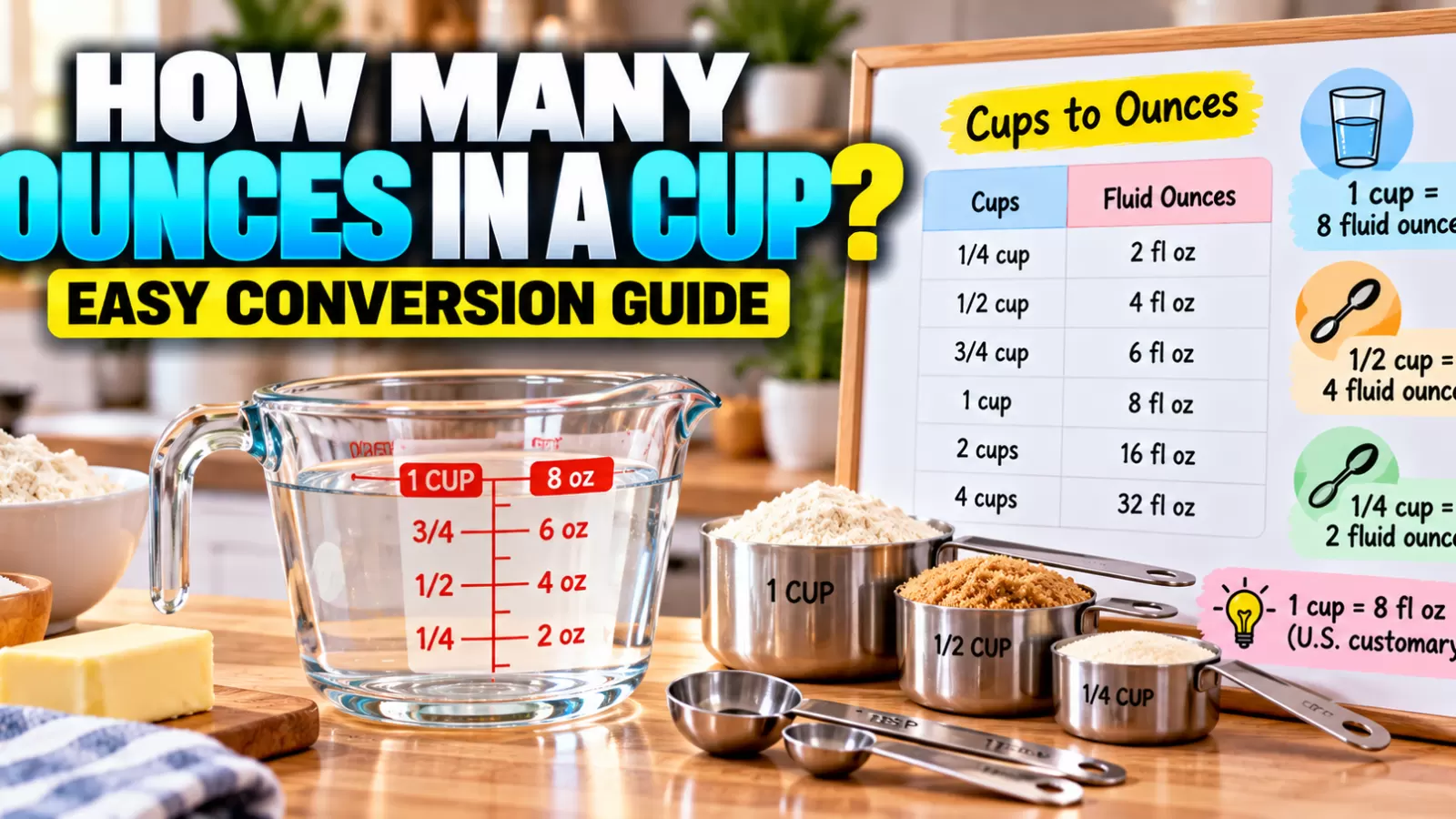
1 U.S. customary cup = 8 fluid ounces
That means:
1/4 cup = 2 fluid ounces
1/2 cup = 4 fluid ounces
3/4 cup = 6 fluid ounces
1 cup = 8 fluid ounces
2 cups = 16 fluid ounces
4 cups = 32 fluid ounces
For liquid volume in standard U.S. cooking measurements, the basic formula is simple:
Cups × 8 = Fluid Ounces
However, there’s an important detail.
Fluid ounces and ounces by weight are not the same thing.
A cup of water and a cup of flour occupy roughly the same volume when measured in the same cup, but they do not have the same weight.
Understanding that distinction can prevent one of the most common mistakes when converting recipes.
Cups to Fluid Ounces Conversion Chart
Here’s a quick reference for common U.S. cooking measurements:
| Cups | Fluid Ounces |
|---|---|
| 1/8 cup | 1 fl oz |
| 1/4 cup | 2 fl oz |
| 1/3 cup | about 2.67 fl oz |
| 1/2 cup | 4 fl oz |
| 2/3 cup | about 5.33 fl oz |
| 3/4 cup | 6 fl oz |
| 1 cup | 8 fl oz |
| 1 1/2 cups | 12 fl oz |
| 2 cups | 16 fl oz |
| 3 cups | 24 fl oz |
| 4 cups | 32 fl oz |
| 8 cups | 64 fl oz |
| 16 cups | 128 fl oz |
These conversions are based on U.S. customary cooking measurements.
The National Institute of Standards and Technology’s kitchen measurement guidance lists 1 cup as approximately 240 mL for practical kitchen conversion and 8 fluid ounces in U.S. customary measurement. NIST
How to Convert Cups to Ounces
For liquid volume, converting cups to fluid ounces is extremely easy.
Use:
Fluid ounces = Cups × 8
For example:
How many ounces are in 2 cups?
2 × 8 = 16
Therefore:
2 cups = 16 fluid ounces
Another example:
How many ounces are in 3 cups?
3 × 8 = 24
Therefore:
3 cups = 24 fluid ounces
The same calculation works with fractions and decimals.
How Many Ounces Are in Half a Cup?
Half a cup contains:
4 fluid ounces
Here’s the calculation:
0.5 × 8 = 4
Therefore:
1/2 cup = 4 fl oz
Half a cup is also equal to approximately:
8 tablespoons
or roughly:
120 milliliters
NIST’s cooking equivalency table gives 120 mL as the approximate metric equivalent of 1/2 cup. NIST
How Many Ounces Are in 1/4 Cup?
One-quarter cup contains:
2 fluid ounces
Calculation:
0.25 × 8 = 2
Therefore:
1/4 cup = 2 fl oz
It’s also approximately:
4 tablespoons
or:
60 milliliters
This is a particularly useful measurement to remember because 1/4 cup appears frequently in recipes.
How Many Ounces Are in 3/4 Cup?
Three-quarters of a cup contains:
6 fluid ounces
Calculation:
0.75 × 8 = 6
Therefore:
3/4 cup = 6 fl oz
It’s also equivalent to:
12 tablespoons
and approximately:
180 milliliters
NIST lists 180 mL as an approximate equivalent for 6 fluid ounces or 3/4 cup. NIST
How Many Ounces Are in 1/3 Cup?
This one isn’t as clean.
One-third of a cup is approximately:
2.67 fluid ounces
The calculation is:
1 ÷ 3 × 8 = 2.666…
Rounded:
1/3 cup ≈ 2.67 fl oz
For everyday cooking, you normally don’t need to measure 2.67 fluid ounces manually if you already have a 1/3-cup measuring cup.
How Many Ounces Are in 2/3 Cup?
Two-thirds of a cup is approximately:
5.33 fluid ounces
Calculation:
2 ÷ 3 × 8 = 5.333…
Therefore:
2/3 cup ≈ 5.33 fl oz
Again, using a dedicated 2/3-cup measure is usually easier when one is available.
How Many Ounces Are in 2 Cups?
Two cups contain:
16 fluid ounces
Calculation:
2 × 8 = 16
Therefore:
2 cups = 16 fl oz
Two U.S. customary cups also equal:
1 pint
This is another useful kitchen conversion to remember.
How Many Cups Are in 16 Ounces?
Now let’s reverse the calculation.
To convert fluid ounces to cups:
Fluid Ounces ÷ 8 = Cups
So:
16 ÷ 8 = 2
Therefore:
16 fluid ounces = 2 cups
This makes converting in either direction straightforward.
Cups → multiply by 8
Fluid ounces → divide by 8
If you want to understand the same type of calculation more generally, BriefTop’s guide to calculating percentages explains simple formulas and step-by-step calculations that can also make everyday conversions easier.
Fluid Ounces vs. Ounces: What’s the Difference?
This is the most important distinction in this entire guide.
Fluid ounces measure volume.
Ounces measure weight or mass.
They aren’t interchangeable.
For example, when a recipe says:
8 fluid ounces of milk
it’s describing a volume.
But when a package says:
8 oz of cheese
it’s normally describing weight.
The FDA’s household-measure guidance reflects this distinction: for nutrition-labeling purposes, it treats 1 fluid ounce as 30 mL while 1 ounce by weight is approximately 28 grams. U.S. Food and Drug Administration
That’s why asking:
How many ounces are in a cup?
requires another question:
Do you mean fluid ounces or ounces by weight?
For liquids measured by U.S. customary volume:
1 cup = 8 fluid ounces.
For ingredients measured by weight, the answer depends on the ingredient.
Are There 8 Dry Ounces in a Cup?
Not necessarily.
This is a very common misconception.
A cup measures volume.
An ounce can measure weight.
Different ingredients have different densities.
Imagine filling identical cups with:
Flour.
Sugar.
Honey.
Butter.
Chocolate chips.
Water.
All the cups can contain the same volume, but their weights can be different.
Therefore, you shouldn’t assume:
1 cup = 8 ounces by weight
for every ingredient.
Instead, use a weight conversion specifically for the ingredient you’re measuring.
Why Flour and Sugar Don’t Weigh the Same Per Cup
Consider a cup filled with loosely packed flour and another filled with granulated sugar.
The containers have the same volume.
But the ingredients have different physical properties and densities.
Their weights therefore differ.
This is why baking recipes sometimes provide measurements in grams instead of cups.
A kitchen scale measures weight directly, which can provide greater consistency than filling a measuring cup differently each time.
Liquid vs. Dry Measuring Cups
Liquid and dry measuring cups measure volume, but they’re designed differently.
Liquid measuring cups
These usually have:
A pouring spout.
Measurement markings on the side.
Extra space above the highest measurement line.
They’re convenient for ingredients such as:
Water.
Milk.
Oil.
Broth.
Juice.
Dry measuring cups
These are usually designed to be filled to the top and leveled.
They’re commonly used for:
Flour.
Sugar.
Rice.
Oats.
Other dry ingredients.
For many recipes, using the appropriate measuring tool makes the process easier and more consistent.
Cups, Ounces, Tablespoons and Teaspoons
Here’s another useful kitchen reference:
| Measurement | Equivalent |
|---|---|
| 1 teaspoon | about 5 mL |
| 1 tablespoon | 3 teaspoons |
| 1 tablespoon | 1/2 fl oz |
| 2 tablespoons | 1 fl oz |
| 4 tablespoons | 1/4 cup |
| 8 tablespoons | 1/2 cup |
| 12 tablespoons | 3/4 cup |
| 16 tablespoons | 1 cup |
| 1 cup | 8 fl oz |
NIST provides similar household measurement equivalents for cooking applications, including 1 tablespoon at approximately 15 mL, 1 fluid ounce at approximately 30 mL and 1 cup at approximately 240 mL. NIST
How Many Milliliters Are in a Cup?
You’ll commonly see two closely related values.
A U.S. customary cup based on exact customary-unit relationships is approximately:
236.6 mL
For practical cooking conversions, however, it’s commonly rounded to:
240 mL
NIST’s detailed household table gives approximately 237 mL for a cup, while its practical Metric Kitchen chart uses 240 mL. NIST
The FDA also specifies 240 mL for 1 cup for nutrition-labeling purposes. U.S. Food and Drug Administration
So if a recipe converts:
1 cup = 240 mL
that’s a normal practical kitchen conversion.
Is a Cup the Same Everywhere in the World?
No.
This is another reason international recipes can be confusing.
A cup isn’t necessarily defined identically in every measurement system.
For example, a metric cup is commonly:
250 mL
while U.S. cooking conversions commonly use approximately:
240 mL
That difference may not matter much for some everyday recipes, but it can become more important when measurements need to be precise.
When following an international recipe, check whether the author is using:
U.S. customary cups.
Metric cups.
Or measurements directly in milliliters and grams.
Quick Cups-to-Ounces Formula
If you’re using U.S. customary liquid volume, remember this:
Cups × 8 = Fluid Ounces
Examples:
0.25 cups × 8 = 2 fl oz
0.5 cups × 8 = 4 fl oz
0.75 cups × 8 = 6 fl oz
1 cup × 8 = 8 fl oz
2 cups × 8 = 16 fl oz
4 cups × 8 = 32 fl oz
To reverse it:
Fluid Ounces ÷ 8 = Cups
Examples:
4 fl oz ÷ 8 = 1/2 cup
8 fl oz ÷ 8 = 1 cup
16 fl oz ÷ 8 = 2 cups
32 fl oz ÷ 8 = 4 cups
Easy Trick to Remember the Conversion
You really only need to remember one number:
8
There are:
8 fluid ounces in 1 U.S. customary cup.
From there:
Half the cup = half the ounces.
1/2 cup = 4 fl oz.
Half again:
1/4 cup = 2 fl oz.
And:
3/4 cup = 6 fl oz.
Once you remember 1 cup = 8 fluid ounces, most common conversions can be done mentally.
Common Conversion Mistakes
Confusing Fluid Ounces With Weight Ounces
This is the biggest one.
fl oz = volume
oz = weight
Don’t automatically convert a cup of a dry ingredient to 8 ounces by weight.
Forgetting Which Cup Standard a Recipe Uses
Recipes from different countries may use different cup definitions.
Check the recipe’s measurement system when precision matters.
Measuring Ingredients Incorrectly
With dry ingredients, how you fill the cup can affect the amount.
Scooping, packing or leveling an ingredient differently can change its weight even when you’re using the same measuring cup.
Assuming Every Ingredient Has the Same Cup-to-Weight Conversion
It doesn’t.
A cup of one ingredient may weigh substantially more or less than a cup of another.
When a recipe provides grams, using a kitchen scale can remove that ambiguity.
Frequently Asked Questions
How many ounces are in 1 cup?
There are 8 U.S. fluid ounces in 1 U.S. customary cup.
How many ounces are in half a cup?
There are 4 fluid ounces in 1/2 cup.
How many ounces are in 1/4 cup?
There are 2 fluid ounces in 1/4 cup.
How many ounces are in 3/4 cup?
There are 6 fluid ounces in 3/4 cup.
How many ounces are in 2 cups?
There are 16 fluid ounces in 2 cups.
How many cups are in 8 ounces?
If you mean U.S. fluid ounces:
8 fluid ounces = 1 cup.
If you mean 8 ounces by weight, the cup equivalent depends on the ingredient.
How many cups are in 16 fluid ounces?
16 fl oz = 2 cups.
Does 8 ounces always equal 1 cup?
No.
8 fluid ounces equals 1 U.S. customary cup by volume.
Eight ounces by weight doesn’t universally equal one cup because the conversion depends on the ingredient.
Is 1 cup 240 mL?
For practical U.S. cooking and FDA nutrition-labeling purposes, 240 mL is commonly used for 1 cup. U.S. Food and Drug Administration
Final Thoughts
So, how many ounces are in a cup?
For U.S. customary liquid measurements, the answer is simple:
1 cup = 8 fluid ounces
From there, the most useful conversions are:
1/4 cup = 2 fl oz
1/2 cup = 4 fl oz
3/4 cup = 6 fl oz
1 cup = 8 fl oz
2 cups = 16 fl oz
The key is remembering that fluid ounces measure volume while ounces can measure weight.
For liquids, the cups-to-fluid-ounces conversion is straightforward.
For dry ingredients measured by weight, you’ll need an ingredient-specific conversion.
Remember those two rules and most cups-and-ounces questions become much easier.