Percentages are everywhere.
You see them when a store offers 25% off, when your salary increases by 5%, when a restaurant adds a tip, when you calculate a test score or when a bank displays an interest rate.
But percentages can become confusing surprisingly quickly.
What is 20% of 150?
What percentage is 45 out of 60?
How much will something cost after a 30% discount?
And how do you calculate the percentage increase between two numbers?
Fortunately, you don’t need advanced mathematics.
Once you understand a few simple formulas, you can solve most everyday percentage problems in seconds.
This guide explains how to calculate percentage step by step, with easy formulas and practical examples you can reuse.
What Is a Percentage?
A percentage represents a number as a fraction of 100.
The word percent essentially means “per hundred.”
For example:
1% = 1 out of 100
10% = 10 out of 100
25% = 25 out of 100
50% = 50 out of 100
100% = 100 out of 100
This is why percentages are useful.
They give us a standard way to compare quantities of different sizes.
According to the National Institute of Standards and Technology, percent is represented using the symbol % and expresses a number in hundredths.
A simple way to remember it is:
Percentage = a portion of 100
How to Calculate Percentage
The basic percentage formula is:
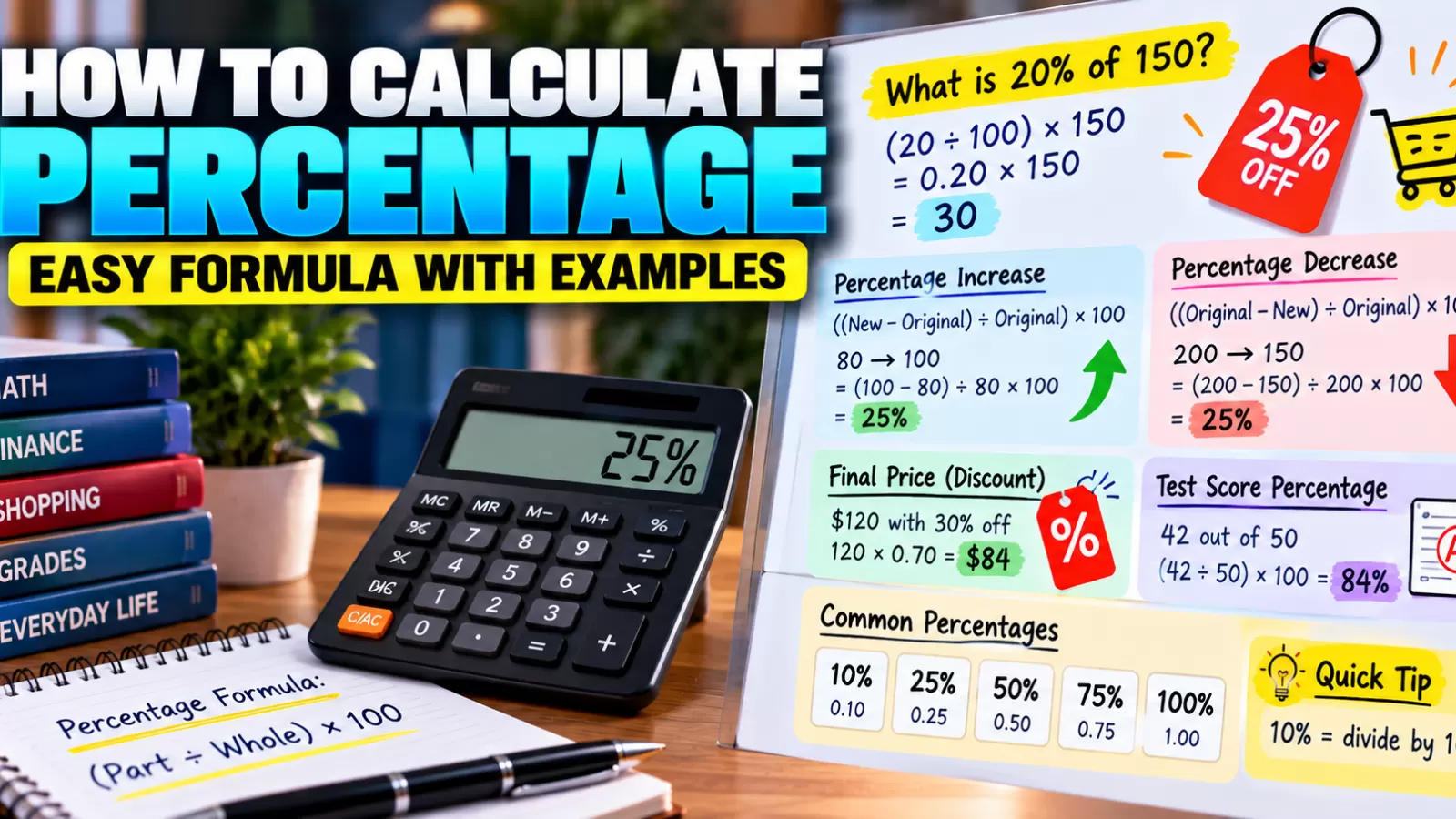
Percentage = (Part ÷ Whole) × 100
Suppose 20 students out of a class of 25 passed an exam.
The calculation would be:
20 ÷ 25 = 0.8
Then multiply by 100:
0.8 × 100 = 80
Therefore:
20 is 80% of 25.
That’s the fundamental percentage formula.
Once you understand it, many other percentage calculations become easier.
How to Find the Percentage of a Number
Another extremely common question is:
What is X% of Y?
Use this formula:
(Percentage ÷ 100) × Number
For example:
What is 20% of 150?
First convert 20% to a decimal:
20 ÷ 100 = 0.20
Then multiply:
0.20 × 150 = 30
Answer: 20% of 150 is 30.
You can use exactly the same formula with almost any number.
Percentage of a Number Examples
Here are several simple examples.
What is 10% of 200?
10 ÷ 100 = 0.10
0.10 × 200 = 20
Answer:
20
What is 25% of 80?
25 ÷ 100 = 0.25
0.25 × 80 = 20
Answer:
20
What is 50% of 300?
50 ÷ 100 = 0.50
0.50 × 300 = 150
Answer:
150
What is 15% of 60?
15 ÷ 100 = 0.15
0.15 × 60 = 9
Answer:
9
The method never changes:
Convert the percentage to a decimal → multiply by the number.
How to Calculate What Percentage One Number Is of Another
Sometimes you know both numbers but don’t know the percentage.
For example:
45 is what percentage of 60?
Use:
(Part ÷ Whole) × 100
So:
45 ÷ 60 = 0.75
Then:
0.75 × 100 = 75%
Therefore:
45 is 75% of 60.
Here’s another example.
If you answered 42 questions correctly on a 50-question test:
42 ÷ 50 = 0.84
Multiply by 100:
0.84 × 100 = 84%
Your score would be:
84%
This is one reason percentages are commonly used for grades.
They allow results from tests containing different numbers of questions to be compared on the same 100-point scale.
The Three Basic Percentage Formulas
Most everyday percentage problems can be solved using three formulas.
Find the Percentage
When you know the part and whole:
Percentage = (Part ÷ Whole) × 100
Example:
30 is what percentage of 120?
30 ÷ 120 × 100 = 25%
Find the Part
When you know the percentage and whole:
Part = (Percentage ÷ 100) × Whole
Example:
What is 25% of 120?
0.25 × 120 = 30
Find the Whole
When you know the part and percentage:
Whole = Part ÷ (Percentage ÷ 100)
Example:
30 is 25% of what number?
30 ÷ 0.25 = 120
These three formulas cover a huge portion of everyday percentage calculations.
Percentage Formula Table
| What You Need | Formula | Example |
|---|---|---|
| Percentage | (Part ÷ Whole) × 100 | 20 ÷ 80 × 100 = 25% |
| Part | (Percentage ÷ 100) × Whole | 25% of 80 = 20 |
| Whole | Part ÷ (Percentage ÷ 100) | 20 ÷ 0.25 = 80 |
Saving these three formulas can make percentage problems considerably easier.
How to Calculate Percentage Increase
Percentage increase measures how much a value has grown relative to its original value.
Use:
Percentage Increase = ((New Value − Original Value) ÷ Original Value) × 100
Suppose something increases from $80 to $100.
First find the difference:
100 − 80 = 20
Divide the increase by the original value:
20 ÷ 80 = 0.25
Multiply by 100:
0.25 × 100 = 25%
The value increased by 25%.
The original value matters here.
A common mistake is dividing by the new number instead.
Percentage Increase Example: Salary
Suppose your salary increases from $40,000 to $42,000.
Difference:
$42,000 − $40,000 = $2,000
Divide by the original salary:
2,000 ÷ 40,000 = 0.05
Multiply by 100:
5%
Your salary increased by 5%.
How to Calculate Percentage Decrease
Percentage decrease works similarly.
Use:
Percentage Decrease = ((Original Value − New Value) ÷ Original Value) × 100
Suppose a price falls from $200 to $150.
Find the decrease:
200 − 150 = 50
Divide by the original value:
50 ÷ 200 = 0.25
Multiply by 100:
25%
The price decreased by 25%.
How to Calculate a Discount Percentage
Discounts are one of the most common real-world uses of percentages.
Suppose a jacket costs $120 and is 30% off.
First calculate 30% of $120:
0.30 × 120 = 36
The discount is:
$36
Subtract that from the original price:
$120 − $36 = $84
Final price: $84
You can also calculate the final price directly.
A 30% discount means you’re paying:
100% − 30% = 70%
Convert 70% to decimal:
0.70
Then:
120 × 0.70 = 84
Same answer:
$84
How to Calculate the Original Price After a Discount
This is slightly different.
Suppose an item costs $70 after a 30% discount.
What was the original price?
If the discount was 30%, you paid 70% of the original price.
Convert that to decimal:
70% = 0.70
Then:
70 ÷ 0.70 = 100
Original price: $100
A common mistake would be simply adding 30% to $70.
That doesn’t work because the 30% discount was calculated from the original price, not the discounted price.
How to Calculate a Tip
Suppose your restaurant bill is $80 and you want to leave a 20% tip.
Calculate:
80 × 0.20 = 16
Tip:
$16
Total:
$80 + $16 = $96
For a 15% tip:
80 × 0.15 = 12
Total:
$92
Quick Mental Trick for Calculating 10%
Calculating 10% is particularly easy.
Simply divide the number by 10.
10% of 200 = 20
10% of 80 = 8
10% of 45 = 4.5
Once you know 10%, you can estimate many other percentages.
For example:
20%
Double 10%.
If 10% of 80 = 8:
20% = 16
5%
Take half of 10%.
If 10% of 80 = 8:
5% = 4
15%
Add 10% and 5%.
10% of 80 = 8
5% of 80 = 4
8 + 4 = 12
Therefore:
15% of 80 = 12.
These shortcuts can be useful when estimating tips, discounts and other everyday calculations.
How to Calculate Percentage Change
Percentage change measures how much something changed compared with its original value.
The general formula is:
Percentage Change = ((New Value − Old Value) ÷ Old Value) × 100
Suppose website traffic increases from 1,000 visitors to 1,250.
Difference:
1,250 − 1,000 = 250
Divide by the original value:
250 ÷ 1,000 = 0.25
Multiply by 100:
25%
Traffic increased by 25%.
If the result is negative, the value decreased.
For example, from 1,000 to 800:
800 − 1,000 = −200
−200 ÷ 1,000 = −0.20
−0.20 × 100 = −20%
That represents a:
20% decrease.
Percentage Change vs. Percentage Difference
These terms are sometimes confused.
Percentage change is generally used when comparing an old value with a new value.
It has a direction.
Something increased or decreased.
Percentage difference is useful when comparing two values where neither one is necessarily the starting point.
A common percentage-difference formula is:
|A − B| ÷ ((A + B) ÷ 2) × 100
The absolute-value bars mean you use the positive difference between the numbers.
For example, compare 40 and 50.
Difference:
10
Average:
(40 + 50) ÷ 2 = 45
Then:
10 ÷ 45 × 100 ≈ 22.22%
Percentage difference:
Approximately 22.2%
How to Convert a Decimal to a Percentage
Multiply the decimal by 100.
Example:
0.25 × 100 = 25%
0.5 × 100 = 50%
0.75 × 100 = 75%
1.25 × 100 = 125%
An easy shortcut is moving the decimal point two places to the right.
0.35 becomes:
35%
How to Convert a Percentage to a Decimal
Do the opposite.
Divide by 100.
25% ÷ 100 = 0.25
50% ÷ 100 = 0.50
8% ÷ 100 = 0.08
125% ÷ 100 = 1.25
You can think of this as moving the decimal point two places to the left.
This conversion is particularly useful because multiplication with percentages usually requires the decimal form.
How to Calculate a Test Score Percentage
Suppose you answered 36 questions correctly out of 40.
Use:
36 ÷ 40 × 100
36 ÷ 40 = 0.9
0.9 × 100 = 90%
Your score:
90%
Another example:
17 correct answers out of 20:
17 ÷ 20 × 100 = 85%
Score:
85%
How to Calculate Percentage on a Calculator
You don’t need a dedicated percentage calculator for most problems.
A regular calculator works.
For example, to calculate 18% of 250:
Enter:
18 ÷ 100 × 250
Result:
45
Alternatively:
0.18 × 250 = 45
Calculator apps may also include a % button, although its behavior can differ depending on the calculator and operation.
Using the decimal method works consistently:
Percentage ÷ 100 × Number
Common Percentage Mistakes
Percentages are simple once you know the formulas, but several mistakes are extremely common.
Using the Wrong Starting Number
When calculating percentage increase or decrease, divide by the original value.
If something rises from 50 to 75:
Increase = 25.
Then:
25 ÷ 50 × 100 = 50%
Not:
25 ÷ 75.
Forgetting to Divide the Percentage by 100
25% isn’t 25 when you’re multiplying.
It’s:
0.25
So:
25% of 80 =
0.25 × 80 = 20
Not:
25 × 80.
Confusing Percentage With Percentage Points
Suppose an interest rate rises from 5% to 7%.
It increased by:
2 percentage points.
But relative to the original 5%, the percentage increase is:
(7 − 5) ÷ 5 × 100 = 40%
Those statements describe the same change differently.
The distinction between percentages and percentage points is important in statistics, economics and news reporting. The OECD glossary explains why changes between percentages are often expressed in percentage points rather than as ordinary percentage changes.
Can a Percentage Be More Than 100%?
Yes.
A percentage greater than 100% simply means the value is greater than the reference amount.
For example:
150% of 100 is:
1.50 × 100 = 150
So:
150% of 100 = 150.
If a company’s sales reach 200% of its original level, sales are now twice the original amount.
Percentages aren’t limited to 100%.
Quick Percentage Reference
| Percentage | Fraction | Decimal |
|---|---|---|
| 1% | 1/100 | 0.01 |
| 5% | 5/100 | 0.05 |
| 10% | 1/10 | 0.10 |
| 20% | 1/5 | 0.20 |
| 25% | 1/4 | 0.25 |
| 50% | 1/2 | 0.50 |
| 75% | 3/4 | 0.75 |
| 100% | 1 | 1.00 |
Remembering common percentages such as 10%, 25%, 50% and 75% can make mental calculations considerably faster.
Frequently Asked Questions
What is the easiest way to calculate a percentage?
To find a percentage of a number, divide the percentage by 100 and multiply by the number.
For example:
20% of 50:
20 ÷ 100 × 50 = 10
How do I calculate what percentage one number is of another?
Divide the first number by the second and multiply by 100.
For example:
25 is what percentage of 100?
25 ÷ 100 × 100 = 25%
How do I add a percentage to a number?
First calculate the percentage, then add it to the original number.
To increase 100 by 20%:
20% of 100 = 20.
100 + 20 = 120.
You can also multiply directly:
100 × 1.20 = 120
How do I subtract a percentage from a number?
Calculate the percentage and subtract it.
To reduce 100 by 20%:
20% of 100 = 20.
100 − 20 = 80.
Or multiply directly:
100 × 0.80 = 80
How do I calculate a percentage increase?
Subtract the original value from the new value, divide the difference by the original value and multiply by 100.
How do I calculate a percentage decrease?
Subtract the new value from the original value, divide by the original value and multiply by 100.
Final Thoughts
Learning how to calculate percentages becomes much easier once you stop trying to memorize individual problems and instead remember a few basic formulas.
The most important one is:
Percentage = (Part ÷ Whole) × 100
To find a percentage of a number:
(Percentage ÷ 100) × Number
For percentage increases and decreases, remember to compare the change with the original value.
With those principles, you can calculate discounts, tips, grades, price changes, salary increases and many other everyday percentage problems.
And when you’re unsure, ask yourself three questions:
What is the whole?
What is the part?
What percentage am I trying to find?
Once you identify those pieces, the calculation usually becomes straightforward.