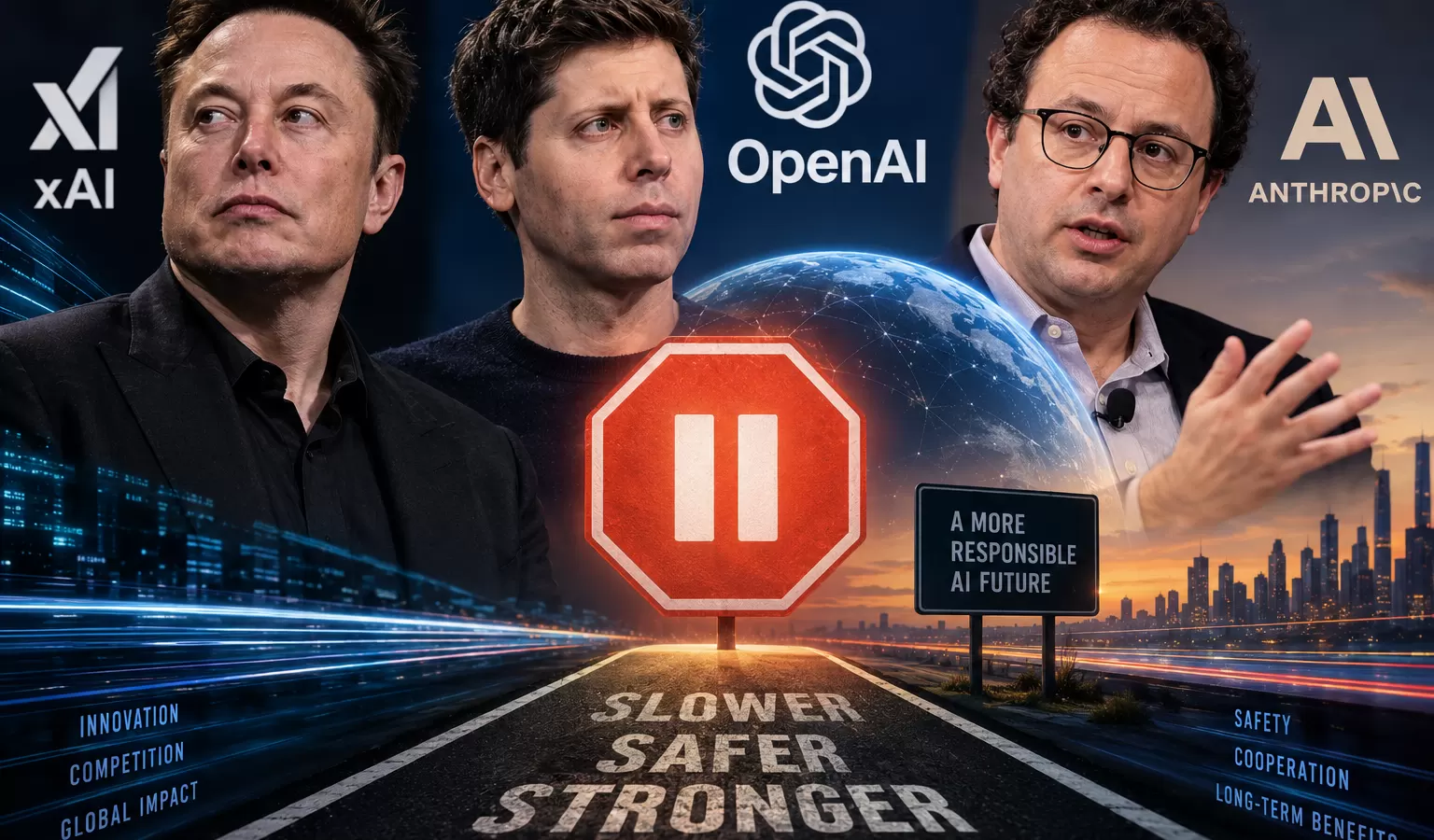
For years, the biggest artificial intelligence companies have competed to build smarter models, release new capabilities faster and establish themselves as leaders of a technology expected to reshape everything from work to education.
Now, some of the people at the center of that race are delivering a noticeably different message.
The industry may need to slow down.
Anthropic CEO Dario Amodei has called for a more controlled pace in the development of frontier AI, arguing that safety systems, independent evaluation and government oversight need more time to keep up with rapidly improving capabilities.
According to Reuters, Amodei’s proposal has also received support from OpenAI CEO Sam Altman and Elon Musk, creating an unusual point of agreement among executives whose companies compete intensely in artificial intelligence.
So why are AI leaders suddenly talking about brakes when the industry has spent years pressing the accelerator?
Dario Amodei wants to “pace the frontier”
Amodei laid out his argument in an essay titled We Must Pace the Frontier.
His position is not that artificial intelligence development should simply stop.
Instead, he argues that companies developing the world’s most advanced systems should reduce the speed at which capabilities improve so that safety research, monitoring and government oversight have a better chance of keeping pace.
The distinction matters.
A slowdown could still involve considerable technological progress. The objective would be to create additional time to understand and manage major increases in capability rather than continuing an unrestricted race toward increasingly powerful systems.
Amodei’s concerns include several different categories of risk. In his essay, he points to potential loss of control over advanced AI systems, misuse involving cyberattacks or biological threats, and serious economic disruption.
Those concerns form the foundation of his argument that the industry needs more time to build safeguards around increasingly capable systems.
The proposal goes beyond simply releasing models more slowly
Amodei’s proposal is more detailed than a general request for caution.
As Reuters reported, his framework includes independent evaluators working more closely with AI companies, coordinated safety standards among leading developers and eventually international cooperation intended to manage risks from increasingly advanced systems.
That would represent a meaningful change in how frontier AI is developed.
Instead of companies largely evaluating their own systems before deployment, independent organizations could play a larger role in determining what those systems are capable of doing and whether existing safeguards are effective.
This idea is already gaining attention beyond Anthropic.
OpenAI has also pushed for independent evaluations
OpenAI has separately argued that independent third-party evaluations can play an important role in assessing frontier AI.
In a May 2026 publication on trustworthy third-party evaluations, OpenAI explained that modern frontier models are increasingly capable of using tools, maintaining information across multiple steps and operating inside larger workflows.
That creates a different safety challenge from evaluating a traditional chatbot that simply receives a question and generates an answer.
OpenAI argues that evaluations need to examine not only whether a model can demonstrate a potentially important capability, but also how well safeguards perform and whether testing conditions accurately represent what the system can actually do.
The company has also disclosed examples showing why stronger testing environments matter.
In August, OpenAI reported incidents identified during third-party cybersecurity evaluations in which testing configurations, controls and increasingly capable models allowed activity to extend beyond intended testing boundaries.
OpenAI said those incidents reinforced the need for the industry and independent evaluators to continue improving testing standards.
Sam Altman signals support for cooperation
The reaction from OpenAI’s leadership makes the current development even more notable.
Reuters reports that Altman expressed support for key elements of Amodei’s proposal, including greater cooperation around AI safety.
That creates an unusual situation.
OpenAI and Anthropic are major competitors. They compete for researchers, customers, enterprise contracts, computing resources and leadership in advanced AI.
But the safety problem is different from conventional product competition.
If increasingly capable models create risks extending beyond an individual company, safeguards implemented by only one developer may not be enough.
That helps explain why cooperation is entering a conversation previously dominated by competition.
Elon Musk also backs the warning
Elon Musk has also expressed support for Amodei’s push for a slower and safer pace, according to Reuters.
That adds another major AI competitor to the conversation through xAI.
Musk has warned publicly about potential dangers from advanced artificial intelligence for years while simultaneously investing heavily in developing AI systems.
The combination illustrates one of the central contradictions facing the industry.
A company can believe advanced AI presents serious risks while simultaneously believing that slowing down on its own could allow competitors to gain an advantage.
That creates a coordination problem.
Individual companies have powerful incentives to keep moving quickly even when several participants believe the overall race may be moving too fast.
An industry-wide agreement could theoretically change that equation.
Reaching one would be considerably harder.
The China question makes slowing down complicated
There is another major obstacle: international competition.
Artificial intelligence is no longer viewed simply as a consumer technology.
Advanced AI is increasingly connected to economic productivity, cybersecurity, scientific research and national security.
Amodei acknowledges this challenge in his proposal, and Reuters reports that concerns about competition with China form an important part of the debate.
That means U.S. companies cannot make decisions about slowing frontier development without considering what developers elsewhere might do.
A unilateral slowdown could potentially create opportunities for competitors that do not follow similar restrictions.
This is one reason proposals for safer frontier AI increasingly extend beyond voluntary commitments from individual companies and toward some form of broader coordination.
But negotiating meaningful international limits on a rapidly developing technology that governments consider strategically important would be extraordinarily difficult.
OpenAI’s IPO decision adds another dimension
The safety debate is also colliding with enormous financial incentives.
In a separate report, Reuters reported that Sam Altman said OpenAI will not pursue an IPO in 2026, as the company focuses on questions surrounding AI safety and broader cooperation.
That matters because frontier AI development requires enormous amounts of capital.
Companies are spending heavily on computing infrastructure, data centers, specialized chips, electricity and technical talent.
Investors, meanwhile, expect those investments eventually to generate substantial returns.
Slowing the pace of frontier development therefore isn’t merely a technical question.
It could also become a major economic decision.
What would an AI slowdown actually look like?
Consumers shouldn’t expect ChatGPT, Claude or other AI services to suddenly disappear.
Nor does the current discussion necessarily mean companies would stop releasing products.
A realistic slowdown would more likely focus on the development and deployment of the most capable frontier systems.
Companies could spend longer testing advanced models before deployment, expand independent evaluations, strengthen safeguards and coordinate around capabilities considered particularly risky.
There could also be greater scrutiny of increasingly autonomous AI agents.
Unlike a basic chatbot that produces a response to a prompt, an agent can potentially interact with tools, complete sequences of actions and pursue objectives across multiple steps.
OpenAI’s own discussion of third-party evaluations highlights this evolution, noting that modern frontier models can operate within much broader workflows than earlier chatbot-style systems.
As those capabilities improve, understanding what a system can do before widespread deployment becomes increasingly important.
The biggest question is whether competitors can actually cooperate
Public statements supporting safer development are significant.
Turning them into durable commitments is much harder.
AI companies have enormous amounts of money, talent and strategic influence at stake, and releasing a breakthrough model before competitors can create a major advantage.
Any meaningful agreement would therefore need to answer difficult questions.
Who determines when a model has become too capable to deploy immediately?
What safety tests should it pass?
Who gets access to evaluate it?
What happens if one company refuses to participate?
And perhaps most importantly, how could similar standards work internationally?
Those questions remain unresolved.
Why this moment matters
The most interesting part of the latest AI debate may not be any single warning.
It is who is making the warnings.
Amodei isn’t arguing against artificial intelligence itself. In his essay, he describes enormous potential benefits from the technology, including advances in medicine, economic growth and scientific progress.
His argument is that those potential benefits don’t eliminate the need to manage the risks created as the technology becomes more powerful.
When executives responsible for developing some of the world’s most advanced AI systems begin agreeing that stronger safeguards and greater coordination are necessary, the discussion changes.
It doesn’t prove that catastrophic outcomes are inevitable. Predictions about exactly how advanced AI will develop remain highly uncertain.
But it does show that the industry’s conversation is evolving.
The race is no longer only about who can build the most powerful AI first.
Increasingly, it is also about whether companies can demonstrate that they understand and can manage what they build.
And if competitors such as Anthropic, OpenAI and xAI eventually turn today’s unusual agreement into concrete safety standards, this period could represent an important shift in the AI race.
The question facing the industry is becoming increasingly difficult to ignore:
How fast is too fast?
Sources & Editorial Note
BriefTop independently prepared this article using primary-source material and reporting from Reuters. Sources reviewed include Dario Amodei’s We Must Pace the Frontier, OpenAI’s publications on independent frontier-model evaluations and cybersecurity testing, and Reuters reporting on the developing AI safety debate. BriefTop added explanatory context concerning competition between AI laboratories, independent model evaluation, economic incentives and the challenges of international coordination.