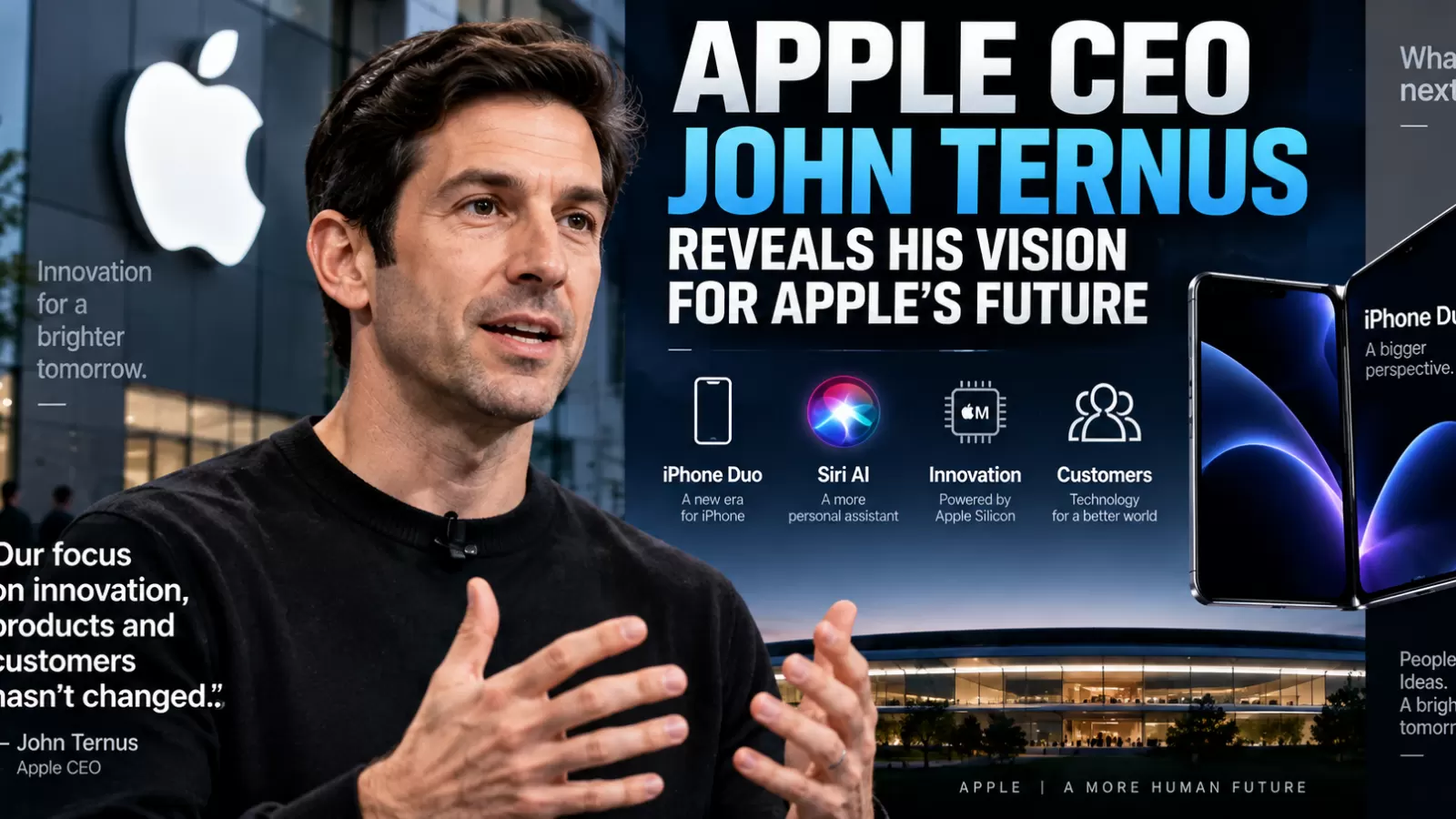
Apple has entered a new era.
Just weeks after officially succeeding Tim Cook as chief executive, Apple CEO John Ternus is beginning to reveal how he sees the future of one of the world’s most influential technology companies.
In a new interview following Apple’s September product event, Ternus discussed everything from the company’s first foldable iPhone to artificial intelligence, Siri and what becoming Apple’s CEO means for him personally.
But anyone expecting an immediate reinvention of Apple may be surprised.
Ternus says he doesn’t view his arrival as the beginning of a radical change.
Instead, his message is centered on something Apple has emphasized for decades:
Products, innovation and customers.
John Ternus Is Now Apple’s CEO
Apple officially announced its leadership transition earlier in 2026.
According to Apple’s official Newsroom announcement, John Ternus became CEO effective September 1, 2026.
Tim Cook, who led Apple for nearly 15 years, transitioned to the role of executive chairman of Apple’s board.
The company said the transition followed a long-term succession planning process and had been unanimously approved by Apple’s board.
Ternus was hardly an outsider.
He joined Apple in 2001 and spent years working in hardware engineering before eventually becoming senior vice president of Hardware Engineering.
That background matters because hardware is now at the center of one of Apple’s biggest questions:
What comes after the traditional iPhone era?
Ternus Says Apple Isn’t Making a Radical Change
Ternus recently sat down for an interview with the French television program Clique following Apple’s September event.
According to a report from MacRumors covering the interview, the new CEO was asked whether Apple was returning to its roots with a renewed focus on engineering and products.
His answer suggested continuity rather than revolution.
Ternus said Apple’s focus on innovation, products and customers hasn’t changed.
That may become one of the defining themes of his early leadership.
Instead of publicly distancing himself from the Tim Cook era, Ternus appears to be presenting his leadership as the next stage of Apple’s existing philosophy.
But the products arriving under his leadership could still look considerably different.
iPhone Duo Becomes an Early Symbol of the Ternus Era
One product already stands out.
iPhone Duo.
Apple unveiled its first foldable iPhone during its September event, giving Ternus an unusually significant product to introduce during his first major keynote as CEO.
The device represents Apple’s entry into a foldable smartphone market that competitors had already been exploring for years.
But Ternus says Apple didn’t simply want to copy existing foldable phones.
In his Clique interview, he explained that Apple wanted to create a large-screen experience that felt right for the company rather than effectively attaching two conventional phone displays together.
Apple drew from its experience designing the iPad when determining the unfolded shape of the device, according to Ternus.
That approach illustrates a broader challenge facing Apple.
The company often enters established product categories later than competitors.
When it does, expectations are enormous.
Apple isn’t simply expected to participate.
Customers expect the company to offer a compelling reason for waiting.
Building a Foldable iPhone Wasn’t Easy
Ternus also discussed some of the engineering challenges behind the iPhone Duo.
Foldable smartphones introduce problems traditional phones don’t have to solve in quite the same way.
The hinge has to survive repeated opening and closing.
The flexible display needs to remain reliable.
Internal components must fit into an unusual physical design.
And the device still needs to feel like a premium smartphone rather than an engineering experiment.
Ternus said Apple’s teams had numerous problems to solve during development, including issues involving the hinge, display and overall reliability.
For someone who spent much of his Apple career overseeing hardware engineering, launching a technically ambitious product so early in his CEO tenure is particularly symbolic.
Apple’s AI Challenge Is Even Bigger
Hardware isn’t Ternus’ only challenge.
Artificial intelligence may ultimately be the more important one.
Apple is competing in an industry where AI assistants are rapidly becoming capable of more than answering basic questions.
Consumers increasingly expect AI systems to understand natural language, work across applications, summarize information and perform increasingly complex tasks.
Apple has been developing a more capable version of Siri as part of that transition.
During his recent interview, Ternus reiterated an interesting part of Apple’s approach to AI.
The company doesn’t want Siri AI to become a replacement for human relationships.
Instead, Apple’s approach emphasizes technology that assists users while remaining integrated into devices and services they already use.
That philosophy differentiates Apple’s public messaging from companies pushing aggressively toward highly autonomous or companion-like AI systems.
Whether consumers ultimately prefer Apple’s approach remains an open question.
Siri AI Could Define Apple’s Next Chapter
For years, Siri was one of the most recognizable digital assistants in the world.
But the generative AI boom dramatically changed consumer expectations.
Typing or speaking a short command is no longer enough.
Users increasingly expect conversational responses and systems that understand context.
That puts significant pressure on Apple.
The iPhone remains one of the world’s most important computing platforms, giving Apple an enormous installed base through which it can distribute new AI capabilities.
But having access to millions of devices doesn’t automatically guarantee leadership in artificial intelligence.
Apple must make Siri genuinely useful in the new AI environment.
And Ternus will now be responsible for overseeing that transition.
Ternus Doesn’t Want to Replace Tim Cook’s Apple
Leadership transitions at companies as large as Apple naturally invite comparisons.
Steve Jobs was closely associated with product vision and theatrical launches.
Tim Cook became known for operational execution and dramatically expanding Apple’s scale.
Now Ternus has to establish his own identity.
However, his early comments suggest he isn’t interested in manufacturing an artificial break from his predecessors.
When Apple announced the leadership change, Ternus acknowledged both Jobs and Cook as important influences on his career.
Cook, meanwhile, publicly praised Ternus’ engineering background and leadership.
That continuity could be important during a period when Apple is simultaneously dealing with changes in hardware, AI and executive leadership.
Tim Cook Isn’t Completely Leaving Apple
Another important detail is that Tim Cook hasn’t simply disappeared from the company.
Under the transition announced by Apple, Cook became executive chairman of the board.
Apple said Cook would continue assisting the company in certain areas, including engagement with policymakers around the world.
That gives Apple something many leadership transitions don’t have:
A former CEO with enormous institutional knowledge who remains directly connected to the company.
It may also give Ternus additional room to focus on products and technology while Cook continues contributing in areas where he has decades of experience.
Why Ternus’ Hardware Background Matters
Ternus spent much of his career building products.
That could influence how Apple approaches its next generation of devices.
The technology industry is moving toward a period where artificial intelligence may reshape the hardware people use every day.
Smartphones won’t disappear overnight.
But AI could increasingly influence:
Cameras.
Wearables.
Headphones.
Smart-home devices.
Computers.
Augmented and mixed reality.
And entirely new product categories.
Apple’s challenge is figuring out which of those opportunities can become products used by hundreds of millions of people.
The iPhone Duo may be an important experiment.
It almost certainly won’t be the last.
Apple’s Biggest Question: What Comes After the iPhone?
For nearly two decades, the iPhone has been central to Apple’s business and identity.
The company has successfully expanded around it.
Apple Watch.
AirPods.
Services.
Mac.
iPad.
Vision products.
But none has replaced the iPhone as the product most closely associated with Apple.
That creates an extraordinary challenge for any new CEO.
Ternus doesn’t necessarily need to replace the iPhone.
He does, however, need to position Apple for a world where smartphones may no longer represent the only dominant personal-computing interface.
Artificial intelligence could accelerate that transition.
Privacy Could Become Apple’s AI Advantage — or Limitation
Apple has spent years emphasizing privacy as a product feature.
That creates both opportunities and challenges in AI.
Consumers increasingly care about what happens to their personal information when interacting with intelligent assistants.
An AI system capable of reading messages, understanding calendars, viewing photos and interacting with applications potentially has access to extraordinarily sensitive information.
Apple’s privacy-focused reputation could therefore become an important competitive advantage.
But building advanced AI while maintaining strict privacy protections can also create technical limitations.
Ternus will need to balance both sides.
The most capable assistant isn’t necessarily the assistant consumers will trust the most.
But an assistant that protects privacy while falling too far behind competitors may not be enough either.
The iPhone Duo Gives Apple a New Hardware Story
Apple’s foldable iPhone gives the company something it hasn’t had in years:
A dramatically different iPhone form factor.
Traditional smartphones have become increasingly mature.
Processors improve.
Cameras improve.
Displays improve.
Battery efficiency improves.
But the fundamental rectangle has remained remarkably consistent.
A foldable changes that.
Whether the iPhone Duo becomes a mainstream product or remains a premium niche device will take time to determine.
Still, its introduction gives Ternus an opportunity to demonstrate his hardware philosophy very early in his tenure.
What Should Apple Watchers Follow Next?
Several areas could define the first years of the Ternus era.
Siri AI
Apple needs to demonstrate that its assistant can compete in a rapidly changing AI market.
iPhone Duo
The first foldable iPhone will test whether Apple can turn an established category into a mainstream part of its ecosystem.
New hardware categories
Investors and customers will be watching for products that extend Apple’s ecosystem beyond traditional smartphones and computers.
Apple Silicon
Apple’s transition to its own chips transformed the Mac and remains strategically important across its hardware lineup.
Privacy
The company will need to demonstrate that advanced AI and strong privacy protections can coexist.
Tim Cook’s continuing role
Cook’s presence as executive chairman makes this a leadership transition rather than a complete departure from the previous era.
A New CEO With an Enormous Inheritance
Ternus isn’t taking over a struggling startup.
He’s inheriting one of the world’s most recognizable brands, an enormous global ecosystem and products used by hundreds of millions of people.
That creates advantages.
It also creates expectations few executives ever face.
Every major Apple product will now be interpreted as evidence of where Ternus intends to take the company.
Every AI delay will receive scrutiny.
Every new device will be compared with Apple’s greatest product launches.
And every decision will inevitably be compared with the Jobs and Cook eras.
Ternus appears to understand that.
His early message isn’t that Apple needs to become something completely different.
It’s that Apple needs to continue building.
Final Thoughts
John Ternus has only recently taken control of Apple, so it would be premature to define his leadership based on a single product event or interview.
But the first pieces of his strategy are becoming visible.
Hardware remains central.
The iPhone is evolving.
Artificial intelligence is becoming increasingly important.
Siri has to adapt.
Privacy remains part of Apple’s identity.
And Tim Cook remains involved as executive chairman.
Perhaps most importantly, Ternus isn’t presenting himself as the executive who has arrived to tear down the Apple that came before him.
He’s presenting himself as a product-focused engineer responsible for building its next chapter.
The difficult part comes now:
Finding out what that next chapter actually looks like.