One of Nintendo’s most celebrated games is returning nearly three decades after it changed the way millions of players experienced 3D adventures.
But Nintendo isn’t simply making The Legend of Zelda: Ocarina of Time prettier.
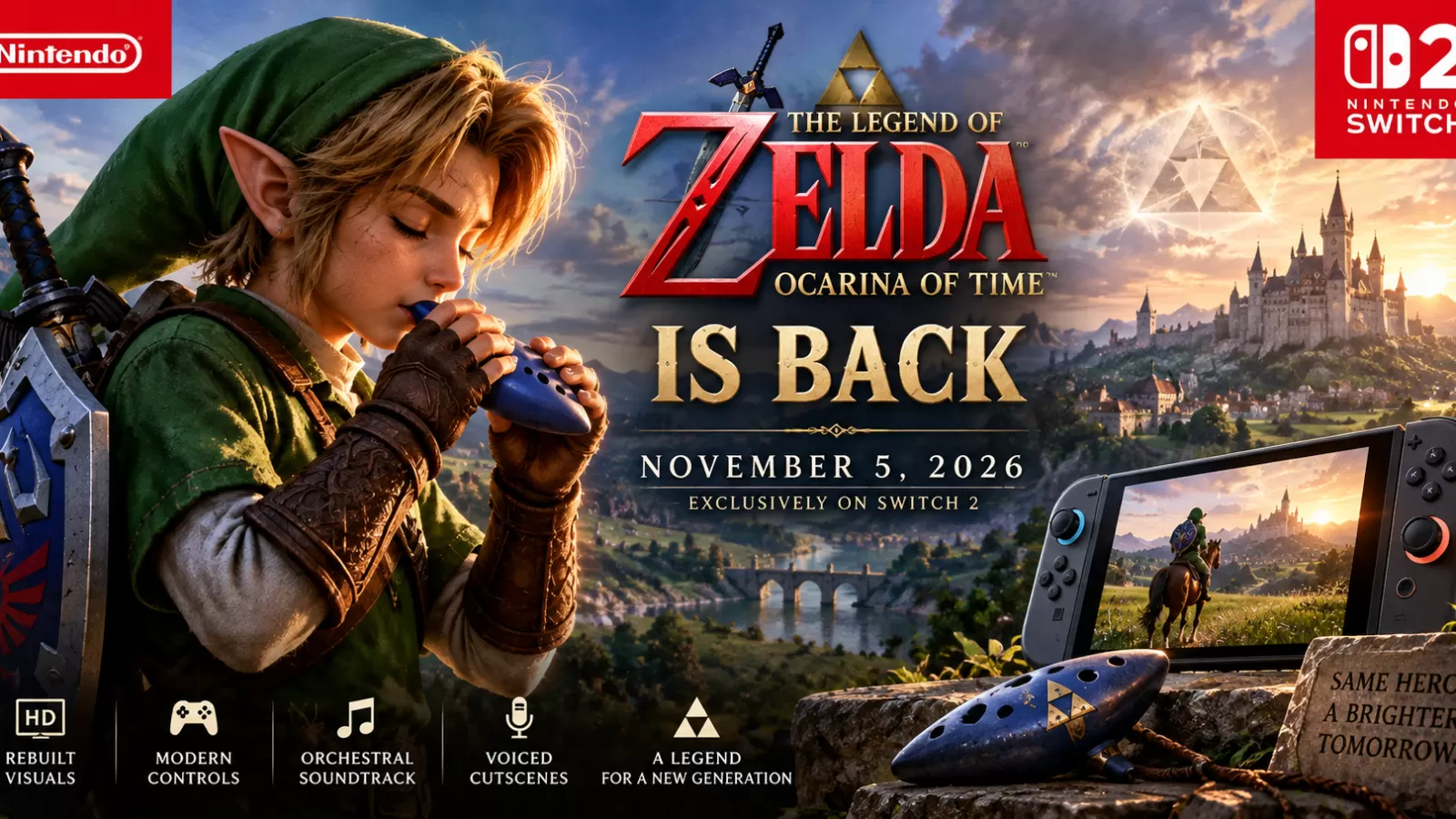
The company has revealed a substantially rebuilt version of the 1998 Nintendo 64 classic for Nintendo Switch 2, complete with overhauled visuals, modernized movement, fully voiced cutscenes, expanded dialogue and an orchestral soundtrack.
And players won’t have to wait very long.
Nintendo has confirmed that the Ocarina of Time remake launches November 5, 2026, exclusively on Nintendo Switch 2.
The announcement was one of the biggest reveals from Nintendo’s celebration of The Legend of Zelda’s 40th anniversary.
Nintendo’s official announcement describes Link’s landmark adventure as being reborn for a new era.
What Nintendo showed makes it clear that “remake” is the important word here.
This isn’t Ocarina of Time with higher-resolution textures
The original Ocarina of Time launched for Nintendo 64 in 1998.
Nintendo could have taken the relatively easy route: increase the resolution, improve textures and sell players a polished version of the classic.
Instead, the company says the visuals have been completely overhauled down to individual material textures.
Locations have been remodeled, performance is smoother, loading is faster and the game’s audio has been refreshed.
Nintendo has also replaced the original musical presentation with symphonic orchestral music.
The goal appears to be preserving the identity of Ocarina of Time while rebuilding the experience around modern hardware.
Nintendo’s official Switch 2 product page describes the adventure as being built from the ground up for Nintendo Switch 2.
But graphics aren’t actually the most interesting change.
Link can finally jump when you tell him to
This sounds almost absurdly simple in 2026.
Link can jump.
On command.
Players of the original Ocarina of Time will immediately understand why that’s significant.
In the Nintendo 64 game, there wasn’t a conventional jump button. Link automatically jumped when running from ledges.
The remake introduces new commands that allow players to jump and run freely.
Nintendo is also adding modern camera controls using the Switch 2’s Right Stick.
That changes something fundamental about how Ocarina of Time feels.
The original was revolutionary partly because Nintendo was still solving the problem of how players should navigate a 3D world using a controller.
Nearly three decades later, those conventions are completely different.
Instead of forcing new players to adapt to controls designed in the 1990s, Nintendo is adapting Ocarina of Time to them.
Hyrule is becoming more alive
Nintendo is also expanding the world itself.
Characters Link encounters will have fully voiced dialogue during expanded cutscenes, and Nintendo says many characters will have considerably more to say.
The day-and-night system is changing too.
In the remake, the cycle continues regardless of where Link happens to be — including towns.
Combined with the remodeled environments and free camera, those changes could make familiar places such as Kokiri Forest and Hyrule feel noticeably different even to players who know the original game almost by memory.
Nintendo detailed these changes in its 40th anniversary presentation announcement.
Nintendo created a new system called Threads of Time
One of the biggest challenges with remaking an older game is deciding how much help modern players should receive.
Ocarina of Time comes from an era when games were often much less explicit about where the player should go next.
Nintendo’s solution is called Threads of Time.
Players can use it to check their progress through the story and identify their next objective.
A large tapestry gradually fills as Link’s journey progresses.
It’s an interesting compromise.
Nintendo doesn’t need to redesign the entire adventure around modern waypoint systems, but someone who gets lost doesn’t necessarily need to search the internet for a walkthrough either.
For younger players experiencing Ocarina of Time for the first time, that could make the game considerably more approachable.
Even playing the ocarina is changing
Then there’s one of the strangest — and potentially most charming — additions.
You can actually hum Zelda melodies.
Nintendo Switch 2’s built-in microphone can recognize a learned melody and have Link perform the corresponding song on his ocarina.
Traditional controls remain available, so nobody is required to start humming at their console.
But the feature shows how far Nintendo is willing to go to reinterpret mechanics that were originally designed around an N64 controller.
The company is even releasing physical ocarina products as part of the anniversary celebration.
Nintendo’s companion ZELDA NOTES service will also gain Ocarina of Time features through the Nintendo Switch App.
Among them are daily accomplishment tracking, location challenges, an interactive virtual ocarina and a quiz containing more than 2,000 questions.
The original story remains at the center
Despite all these changes, Nintendo isn’t trying to replace what made Ocarina of Time famous.
The central adventure remains familiar.
Ganondorf seeks the Triforce.
Link travels across Hyrule and between different periods of his life in an effort to stop him.
The dungeons, puzzles, exploration and equipment that defined the original remain central to the experience.
Longtime Zelda producer Eiji Aonuma has described Nintendo’s approach as a faithful interpretation using modern technologies, according to The Verge’s coverage of the announcement.
That distinction may ultimately determine whether the remake succeeds.
Nintendo isn’t trying to reinvent Ocarina of Time’s identity.
It’s trying to remove nearly 30 years of technological distance between the game and today’s players.
How much will Ocarina of Time cost?
Nintendo’s U.S. store lists the digital edition at $59.99.
The game releases on November 5, 2026 and is exclusive to Nintendo Switch 2.
The official product listing also reveals an estimated 27GB file size and support for TV, tabletop and handheld play.
You can find the current release information directly on Nintendo’s official Ocarina of Time store page.
Physical copies are also planned. The Verge reports a regular physical price of $69.99, although retailer promotions can differ.
Nintendo is also launching a Zelda Switch 2
The game isn’t arriving alone.
As part of Zelda’s 40th anniversary celebration, Nintendo has revealed a special Anniversary Edition Nintendo Switch 2 system.
The Zelda-themed console launches October 29, exactly one week before Ocarina of Time.
However, buyers should notice an important detail:
The game isn’t included with the special-edition console.
The system and remake are separate purchases.
Nintendo is also preparing themed accessories, new amiibo figures for 2027 and other products celebrating the franchise’s anniversary.
November is becoming a fascinating month for gaming
Nintendo also picked an interesting release window.
Ocarina of Time arrives November 5.
That’s the same month currently scheduled to bring another enormous game: Grand Theft Auto VI.
The two games aren’t direct platform competitors — Ocarina of Time is a Switch 2 exclusive, while GTA VI targets PlayStation 5 and Xbox Series consoles — but they will compete for something every major publisher wants during the holiday season:
Players’ attention.
GamesRadar notes that several publishers have already shifted releases around the unusually competitive late-2026 calendar.
Nintendo appears willing to stay.
That says something about how important Ocarina of Time is to its holiday strategy.
Why remake Ocarina of Time now?
There may never have been a more logical moment.
Zelda is celebrating its 40th anniversary.
Nintendo has a new console that needs major exclusive games.
And an entire generation of Switch owners either wasn’t alive when Ocarina of Time originally launched or has never experienced it without decades-old hardware and control conventions standing between them and the game.
For veteran players, Nintendo is selling nostalgia transformed by modern technology.
For everyone else, it’s essentially presenting Ocarina of Time as a new Zelda game.
That’s why the changes matter.
Better graphics alone wouldn’t erase the distance between 1998 and 2026.
Modern movement, free camera control, expanded dialogue, orchestral music, accessibility features and a rebuilt Hyrule might.
Ocarina of Time helped define what a 3D adventure could be almost three decades ago.
On November 5, Nintendo gets to find out whether the same adventure can capture another generation.