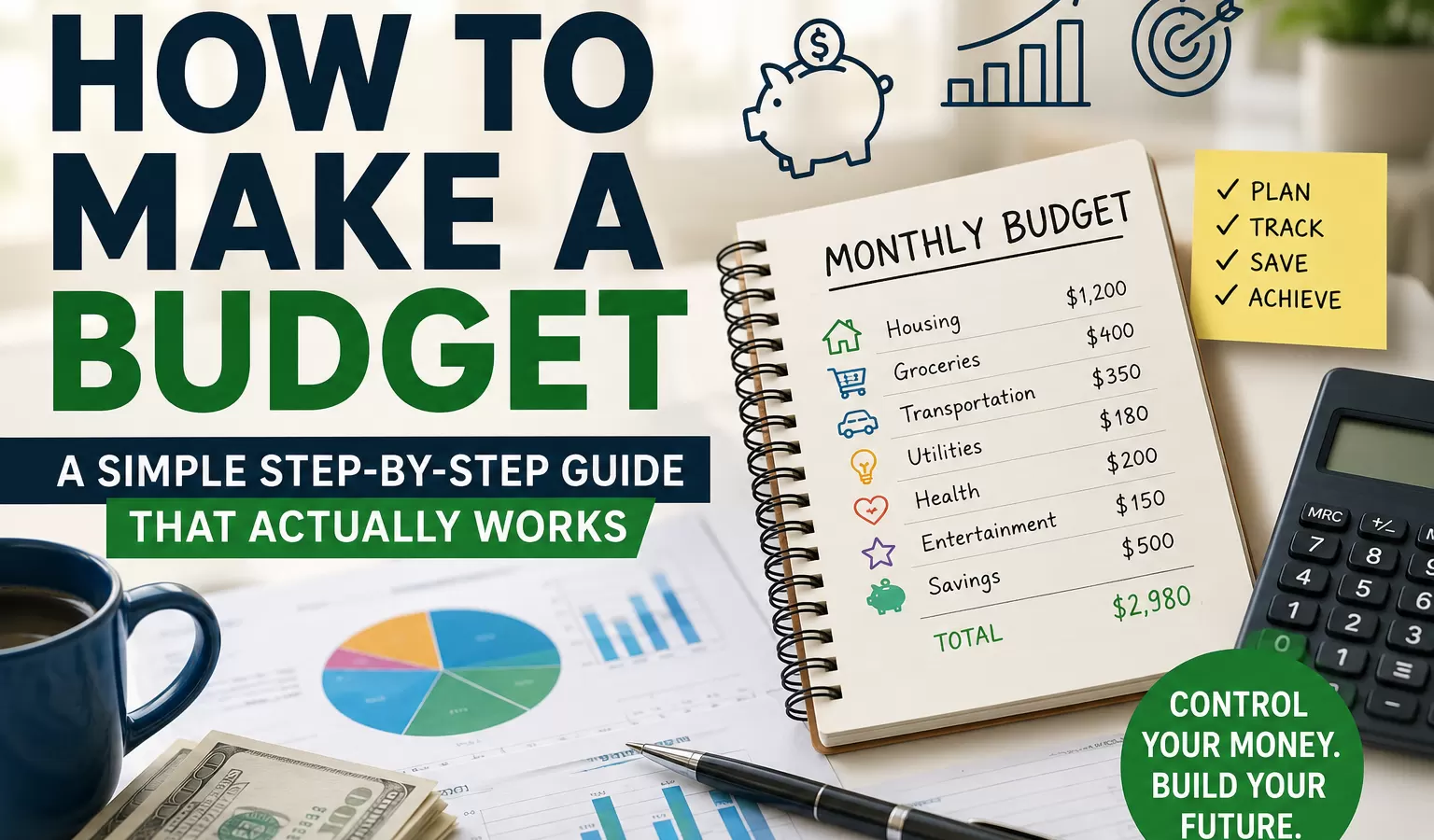
Creating a budget may sound restrictive, but a good budget isn’t about telling yourself that you can’t spend money.
It’s about deciding where your money should go before it disappears.
Whether you’re trying to stop living paycheck to paycheck, pay down debt, build an emergency fund or simply understand where your money goes every month, learning how to make a budget is one of the most useful financial skills you can develop.
And you don’t need complicated software or an accounting degree.
You can build a practical monthly budget in seven steps.
1. Calculate Your Monthly Take-Home Income
Before deciding how much you can spend, you need to know how much money you actually have available.
Start with your take-home pay — the amount deposited into your account after taxes and other payroll deductions.
If you receive a regular paycheck, this calculation is relatively simple.
For example:
Monthly take-home income: $4,000
But income isn’t always that predictable.
If you’re self-employed, work on commission, receive tips or have multiple income sources, review several months of income and calculate a conservative monthly average.
Possible income sources include:
- Salary or wages
- Freelance income
- Business income
- Tips and commissions
- Rental income
- Side jobs
- Other recurring income
Avoid building your normal budget around bonuses or other income you cannot reasonably expect every month.
Your budget should work even during an ordinary month.
2. List Your Fixed Monthly Expenses
Next, identify expenses that remain relatively consistent.
These may include:
- Rent or mortgage
- Car payment
- Insurance
- Internet
- Phone service
- Childcare
- Subscriptions
- Minimum debt payments
Suppose our hypothetical household has these fixed expenses:
Rent: $1,200
Car payment: $350
Insurance: $200
Phone and internet: $150
Subscriptions: $50
Minimum debt payments: $200
Total fixed expenses: $2,150
With $4,000 of take-home income, that leaves $1,850 before accounting for variable expenses and savings.
3. Track Your Variable Spending
This is where many budgets become inaccurate.
If you regularly find that your income disappears before your next payday, our guide on how to stop living paycheck to paycheck explains how to create more financial breathing room.
Variable expenses change from month to month and can be surprisingly easy to underestimate.
Examples include:
- Groceries
- Gas
- Restaurants
- Coffee
- Entertainment
- Clothing
- Personal care
- Household purchases
- Transportation
- Online shopping
Don’t guess.
Review your bank and credit-card transactions from the previous two or three months.
You might think you spend $250 per month eating out and discover that the real number is $480.
That isn’t necessarily a reason to feel guilty.
It’s information.
A budget becomes useful when it’s based on what you’re actually doing, not what you imagine you’re doing.
4. Separate Needs From Wants
Once you know where your money goes, divide your expenses into broad categories.
A need is generally something required for basic living or essential financial obligations.
Examples might include housing, basic groceries, utilities, necessary transportation, insurance and minimum debt payments.
A want improves your lifestyle but can generally be reduced or eliminated if necessary.
Examples might include:
- Restaurant meals
- Streaming subscriptions
- Vacations
- Premium clothing
- Entertainment
- Nonessential shopping
The distinction isn’t always perfect.
A phone, for example, may be essential. A $1,500 phone upgrade every year probably isn’t.
The objective isn’t to eliminate everything enjoyable.
It’s to understand which expenses you could adjust if your financial situation changed.
5. Consider the 50/30/20 Budget Rule
One popular starting framework is the 50/30/20 rule.
Under this approach, your after-tax income is divided broadly into:
50% for needs
Housing, groceries, utilities, transportation, insurance and other essentials.
30% for wants
Restaurants, entertainment, travel, hobbies and other discretionary purchases.
20% for savings and debt goals
Emergency savings, retirement contributions and debt repayment beyond required minimums.
For someone bringing home $4,000 per month, that would look approximately like this:
| Category | Percentage | Monthly Amount |
|---|---|---|
| Needs | 50% | $2,000 |
| Wants | 30% | $1,200 |
| Savings/Debt | 20% | $800 |
| Total | 100% | $4,000 |
This framework is useful because it’s simple.
But it is not a requirement.
Someone living in a high-cost city might need 60% or more of take-home income for necessities. Someone living with family temporarily may spend considerably less.
Use the percentages as a reference point, not a financial law.
The Consumer Financial Protection Bureau provides educational materials explaining this type of needs/wants/savings budgeting framework.
See budgeting resources from the Consumer Financial Protection Bureau
6. Give Your Savings a Purpose
Simply adding a category called “savings” isn’t always enough.
Decide what you’re saving for.
Your goals might include:
- Emergency fund
- Retirement
- Home down payment
- New vehicle
- Vacation
- Education
- Major home repairs
Then assign an amount to each goal.
For example:
Emergency fund: $300/month
Retirement: $300/month
Vacation fund: $100/month
Car repair fund: $100/month
Total: $800/month
Now your savings aren’t whatever happens to remain at the end of the month.
They’re part of the budget from the beginning.
7. Build an Emergency Fund
Unexpected expenses are one of the biggest reasons budgets fail.
The car needs repairs.
An appliance breaks.
You have an unexpected bill.
Your income temporarily falls.
Without savings, an unexpected expense can end up on a credit card and become a much larger financial problem.
That’s why an emergency fund deserves its own category.
The Consumer Financial Protection Bureau describes an emergency fund as cash set aside specifically for unplanned expenses or financial emergencies.
Read the CFPB guide to building an emergency fund
You don’t necessarily need thousands of dollars immediately.
If you’re starting from zero, establishing a smaller initial goal can make the process feel much more achievable.
The important part is beginning and contributing consistently.
Monthly Budget Example
Let’s put everything together.
Imagine someone takes home $4,000 per month.
Their budget might look like this:
| Expense | Amount |
|---|---|
| Rent | $1,200 |
| Utilities | $180 |
| Groceries | $400 |
| Transportation | $350 |
| Insurance | $200 |
| Phone/Internet | $150 |
| Debt payments | $200 |
| Restaurants | $250 |
| Entertainment | $150 |
| Personal/Shopping | $200 |
| Emergency savings | $300 |
| Retirement/Long-term savings | $300 |
| Other savings | $120 |
| TOTAL | $4,000 |
Every dollar now has a purpose.
That doesn’t mean the plan will work perfectly.
Maybe groceries cost $450 instead of $400.
You could reduce another category by $50.
The point is to make adjustments without allowing total spending to consistently exceed your available income.
How to Budget When Your Income Changes Every Month
Budgeting can be more challenging for freelancers, business owners, commission-based workers and anyone whose income fluctuates.
One approach is to build your essential budget around a conservative estimate of your normal income.
Look at your income history rather than your best month.
Then prioritize:
- Housing
- Food
- Utilities
- Transportation
- Insurance
- Required debt payments
- Savings
- Discretionary spending
During higher-income months, consider putting some of the additional money aside rather than immediately increasing your lifestyle expenses.
That reserve can help during slower months.
How to Stop Overspending
Making a budget takes minutes.
Following one takes considerably longer.
If you’re consistently overspending, identify which category is causing the problem instead of declaring the entire budget a failure.
Suppose you budget $300 for restaurants but repeatedly spend $600.
You have several choices.
Reduce restaurant spending.
Increase the restaurant budget and reduce another category.
Or increase your income.
What doesn’t work indefinitely is pretending you only spend $300.
A realistic budget is better than a perfect-looking budget you never follow.
Automate Important Financial Goals
Automation can make budgeting easier.
Consider scheduling automatic transfers shortly after payday for goals such as:
- Emergency savings
- Retirement
- Investments
- Debt payments
- Sinking funds
This changes the order in which you manage money.
Instead of:
Income → Spend → Save whatever remains
you move toward:
Income → Save → Pay obligations → Spend what’s available
Automation also reduces the number of financial decisions you have to make every month.
Review Your Budget Every Month
Your first budget probably won’t be perfect.
That’s normal.
At the end of each month, compare your planned spending with what actually happened.
Ask:
Where did I overspend?
Where did I spend less than expected?
Did my income change?
Did an unexpected expense occur?
Did I reach my savings goal?
Then adjust the next month’s budget.
Your budget should change when your life changes.
Moving, getting married, having a child, changing jobs, paying off a loan or receiving a raise can all require a new plan.
Common Budgeting Mistakes to Avoid
Making the Budget Too Restrictive
If you normally spend $400 on entertainment, immediately budgeting $0 may not be realistic.
Gradual changes are often easier to maintain.
Forgetting Irregular Expenses
Not every expense occurs monthly.
Car registration, holiday gifts, annual subscriptions, school expenses and insurance premiums can appear only once or twice per year.
Divide predictable annual expenses by 12 and save that amount monthly.
Forgetting Small Purchases
A $5 purchase doesn’t seem significant.
Repeated frequently, however, small purchases can become a meaningful monthly expense.
Spending First and Saving Later
If saving depends entirely on having money left over, you may discover there’s rarely anything left.
Treat savings as a planned budget category.
Copying Someone Else’s Budget
Two people earning exactly the same salary can have completely different financial circumstances.
Use examples for guidance, but build your budget around your own income, expenses and priorities.
Do You Need a Budgeting App?
Not necessarily.
A budget can be maintained using:
- Paper and pen
- Spreadsheet
- Banking tools
- Budgeting app
- Personal finance software
The best method is the one you’ll actually continue using.
Someone who enjoys spreadsheets may prefer detailed tracking.
Someone else may need only a few broad categories and automatic transfers.
Complexity doesn’t automatically make a budget better.
Consistency matters more.
How Often Should You Make a Budget?
For most people, reviewing the budget once per month is a practical starting point.
However, checking your spending more frequently can prevent surprises.
A quick weekly review can show whether you’re approaching the limit for categories such as restaurants, entertainment or shopping.
Think of the monthly budget as your plan and weekly reviews as course corrections.
Frequently Asked Questions
What is the easiest way to make a budget?
Start by calculating your take-home income, listing fixed and variable expenses, setting savings goals and making sure planned spending does not exceed available income.
What is the 50/30/20 rule?
It’s a budgeting framework that divides after-tax income into approximately 50% for needs, 30% for wants and 20% for savings and debt goals.
The percentages can be adjusted according to your circumstances.
How much money should I save each month?
There isn’t one percentage appropriate for everyone.
Your income, essential expenses, debt and financial goals all matter. The 20% component of the 50/30/20 framework can provide a starting target, but some households may need to begin lower while others may be able to save considerably more.
Can I make a budget if I have a low income?
Yes.
Budgeting cannot solve an income shortage by itself, but it can help you understand exactly where your available money is going and prioritize essential expenses.
Should I budget every dollar?
You can.
Some people prefer a zero-based approach where income minus planned spending and saving equals zero.
That doesn’t mean spending your entire paycheck. Money assigned to savings also has a job.
The Bottom Line
Learning how to make a budget isn’t about creating the perfect spreadsheet.
It’s about gaining control over your money.
Start with your real take-home income.
Understand what you’re actually spending.
Separate necessities from discretionary purchases.
Make saving part of the plan.
Prepare for unexpected expenses.
Then review your progress and adjust.
Your first budget won’t be perfect, and it doesn’t need to be.
A simple financial plan that you consistently follow is far more valuable than a complicated budget you abandon after one month.
Editorial note: This article is for general educational purposes and does not constitute individualized financial advice.
Trusted Resources
Consumer Financial Protection Bureau (CFPB): Budgeting and consumer financial education resources.
USA.gov: Official U.S. government resources covering personal finance, benefits and consumer information.
Federal Trade Commission (FTC): Consumer protection information involving credit, debt, scams and financial services.