When you’re carrying balances on several credit cards or loans, deciding which debt to pay first can be surprisingly difficult.
Should you attack the smallest balance?
Or should you focus on the debt charging the highest interest rate?
Those two approaches are commonly known as the:
Debt snowball method
and
Debt avalanche method
Both strategies have the same basic objective: continue making required payments on your debts while directing as much extra money as possible toward one balance at a time.
The major difference is which balance gets attacked first.
Understanding the debt snowball vs. debt avalanche comparison can help you choose a strategy that fits both your finances and your personality.
Let’s break down exactly how each method works.
What Is the Debt Snowball Method?
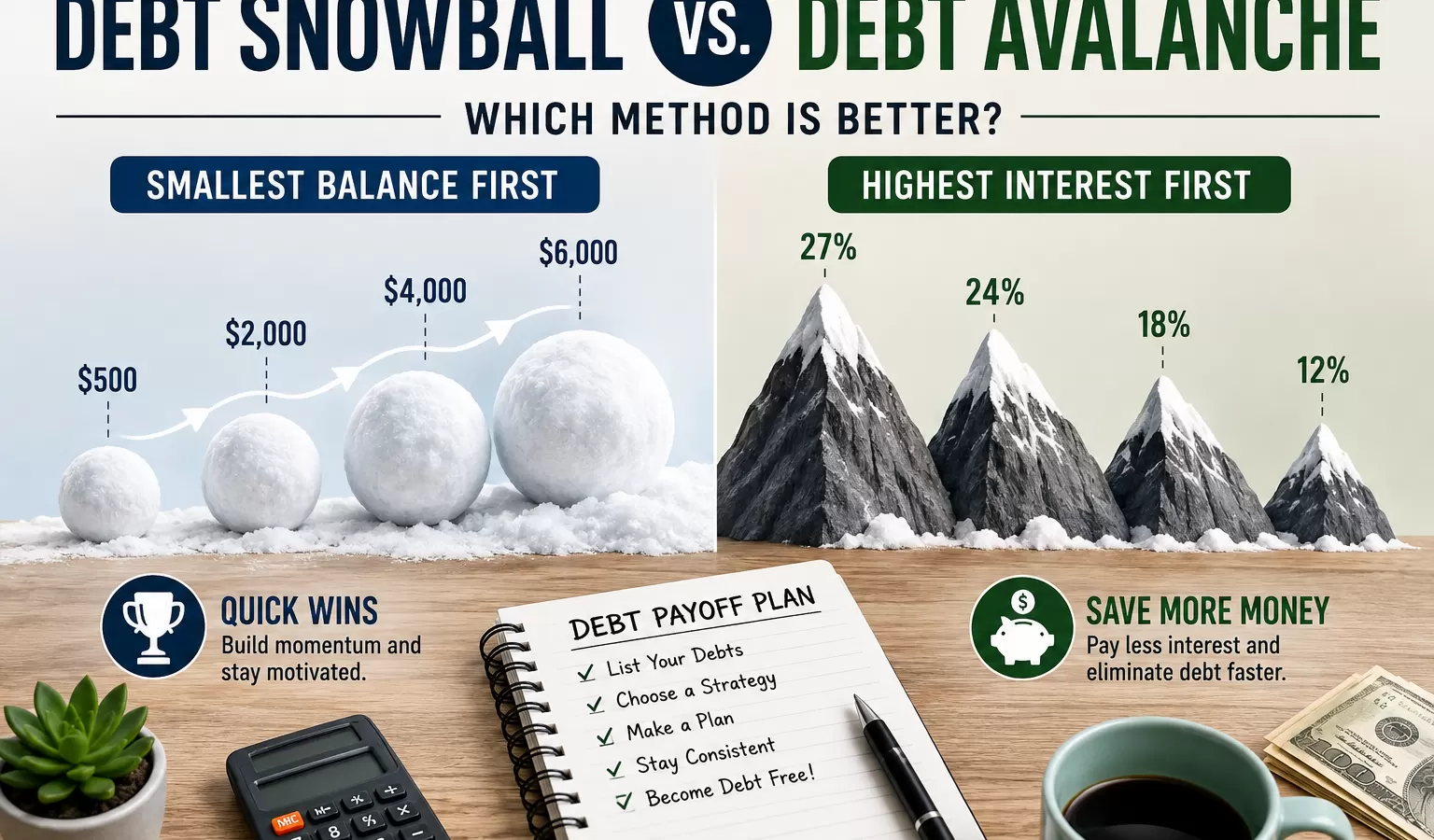
The debt snowball method prioritizes your debts based on balance size.
You start with the smallest balance, regardless of its interest rate.
Once that debt reaches zero, you redirect the money you were paying toward the next-smallest balance.
The process continues until all debts are eliminated.
Think of it like a snowball rolling downhill.
As each debt disappears, the amount available for attacking the next debt can become larger.
Debt Snowball Example
Suppose you have four debts:
| Debt | Balance | Interest Rate | Minimum Payment |
|---|---|---|---|
| Credit Card A | $500 | 18% | $30 |
| Credit Card B | $2,000 | 27% | $70 |
| Personal Loan | $4,000 | 12% | $120 |
| Credit Card C | $6,000 | 24% | $180 |
Total debt:
$12,500
Suppose you have an additional:
$300 per month
available for debt repayment.
Using the snowball method, you would attack:
1. $500 Credit Card A
Then:
2. $2,000 Credit Card B
Then:
3. $4,000 Personal Loan
Finally:
4. $6,000 Credit Card C
Notice something important.
Credit Card A does not have the highest interest rate.
You attack it first because it has the smallest balance.
Why Does the Debt Snowball Method Work?
The appeal is psychological.
Suppose you eliminate that first $500 balance relatively quickly.
You now have:
One fewer debt.
That visible progress can make continuing easier.
After eliminating the first account, the money previously going toward it becomes available for the next debt.
For example:
Old minimum payment: $30
Extra debt payment: $300
Once the first debt disappears, you potentially have:
$330
available to add toward your next target, in addition to that debt’s existing required payment.
The process continues as additional balances reach zero.
Advantages of the Debt Snowball Method
Quick Wins
Small balances may disappear relatively quickly.
Motivation
Seeing accounts reach $0 can provide psychological momentum.
Simplicity
You don’t need complicated calculations.
Just arrange balances from smallest to largest.
Fewer Accounts to Manage
As small debts disappear, your number of outstanding balances decreases.
Disadvantages of the Debt Snowball Method
The biggest disadvantage is mathematical.
Your smallest debt may not be your most expensive debt.
While you’re paying a low-interest $500 balance, a larger balance carrying a much higher interest rate may continue accumulating more interest.
As a result, the snowball approach can potentially cost more in total interest than prioritizing the highest-interest debt.
That’s where the avalanche method comes in.
What Is the Debt Avalanche Method?
The debt avalanche method prioritizes debts based on interest rate rather than balance.
You attack the debt carrying the highest interest rate first.
After eliminating it, you move to the debt with the next-highest rate.
Continue until every balance reaches zero.
Debt Avalanche Example
Let’s use the same debts:
| Debt | Balance | Interest Rate |
|---|---|---|
| Credit Card A | $500 | 18% |
| Credit Card B | $2,000 | 27% |
| Personal Loan | $4,000 | 12% |
| Credit Card C | $6,000 | 24% |
Using the avalanche method, your order changes.
You would attack:
1. Credit Card B — 27%
Then:
2. Credit Card C — 24%
Then:
3. Credit Card A — 18%
Finally:
4. Personal Loan — 12%
The balances no longer determine priority.
Interest rates do.
Why Does the Debt Avalanche Method Work?
Interest is the cost of borrowing money.
A balance charging 27% is generally more expensive to carry than a comparable balance charging 12%.
By eliminating the highest-rate debt first, you’re targeting the debt that is potentially costing you the most.
The Consumer Financial Protection Bureau describes the highest-interest-rate strategy as one that can save money in the long run.
Advantages of the Debt Avalanche Method
Can Reduce Interest Costs
You’re attacking expensive debt first.
Mathematically Efficient
When comparing identical payment amounts and circumstances, prioritizing higher rates generally reduces interest expense.
Useful for High-Interest Credit Cards
The difference can become significant when some cards carry particularly high APRs.
Clear Priority
Simply rank debts from highest APR to lowest APR.
Disadvantages of the Debt Avalanche Method
The biggest disadvantage is motivation.
Suppose your highest-interest debt is:
$9,000
while another balance is only:
$400
The avalanche strategy tells you to attack the $9,000 debt first.
It may take months before an entire account reaches zero.
Some people find that discouraging.
That’s why the mathematically efficient strategy isn’t automatically the best behavioral strategy for every person.
Debt Snowball vs. Debt Avalanche: The Main Difference
Here’s the simplest comparison:
| Feature | Debt Snowball | Debt Avalanche |
|---|---|---|
| First priority | Smallest balance | Highest interest rate |
| Main advantage | Quick wins | Potential interest savings |
| Motivation | Often higher early | May take longer |
| Mathematical efficiency | Potentially lower | Generally higher |
| Complexity | Very simple | Very simple |
| Best for | Motivation-focused payoff | Interest-focused payoff |
Neither strategy changes the amount you originally borrowed.
The difference is the order in which you eliminate your debts.
Which Method Saves More Money?
Generally:
Debt avalanche.
Why?
Because you’re eliminating the highest-interest debt first.
Imagine two cards:
Card A
Balance: $5,000
APR: 29%
Card B
Balance: $1,000
APR: 15%
The snowball method prioritizes:
Card B
because $1,000 is the smaller balance.
The avalanche method prioritizes:
Card A
because 29% is the higher interest rate.
While you’re attacking Card B under the snowball strategy, the larger 29% balance remains outstanding.
Over time, that difference can result in additional interest expense.
The exact savings depend on balances, APRs, payment amounts, fees and timing.
Which Method Pays Off Debt Faster?
This requires an important distinction.
If you make exactly the same total payments every month, the avalanche method can sometimes eliminate all debt sooner because less money may be lost to interest.
But the real world introduces another factor:
behavior.
Suppose the snowball method motivates you so much that you:
- Cut additional expenses
- Make larger payments
- Stay consistent
- Avoid new debt
Then snowball could work better for you in practice.
A mathematically optimal plan doesn’t help if you abandon it.
When the Debt Snowball May Be Better
Consider snowball if:
- You have several small balances
- You feel overwhelmed by the number of debts
- Quick progress motivates you
- You’ve previously abandoned repayment plans
- Simplifying your finances is a major priority
Imagine having:
8 separate debts
Eliminating three small balances within several months could dramatically simplify your finances.
That psychological benefit can matter.
When the Debt Avalanche May Be Better
Consider avalanche if:
- Some debts have very high APRs
- Minimizing interest is your priority
- You’re comfortable waiting longer for the first account to disappear
- You’re disciplined about following financial plans
- Your highest-interest debt is significantly more expensive than your other balances
For example:
Credit Card A: 30%
Credit Card B: 27%
Car loan: 7%
Student loan: 5%
The high-interest credit cards are costing considerably more per borrowed dollar than the lower-rate loans.
The avalanche method targets that difference.
Can You Combine Snowball and Avalanche?
Yes.
Personal finance doesn’t require you to follow one method perfectly.
Suppose you have:
$200 balance at 10%
$3,000 balance at 29%
$5,000 balance at 24%
You might decide to eliminate the tiny:
$200 balance first
for an immediate win.
Then switch to avalanche and attack:
29% → 24%
This hybrid strategy combines psychological momentum with interest-rate prioritization.
The important thing is having a deliberate plan rather than randomly distributing extra payments.
Step 1: List Every Debt
Before choosing either method, create a complete debt inventory.
Write down:
- Creditor
- Balance
- APR
- Minimum payment
- Due date
Include:
- Credit cards
- Personal loans
- Auto loans
- Medical debt
- Student loans
- Other consumer debts
Different debts can have different rules, protections and consequences, so understand each account before changing how you pay it.
Step 2: Determine How Much Extra You Can Pay
Suppose your required minimum payments total:
$450 per month
After reviewing your budget, you determine you can afford another:
$300
Your total monthly debt-payment budget becomes:
$750
Continue making required payments on all debts.
Then direct the extra:
$300
toward your target debt.
If you don’t know how much money is available, start with BriefTop’s How to Make a Budget: A Simple Step-by-Step Guide That Actually Works.
Step 3: Choose Your Priority
Now decide what matters most.
If you want quick wins:
Choose the smallest balance.
If you want to prioritize interest savings:
Choose the highest APR.
Don’t keep changing strategies every month because another balance suddenly looks attractive.
Consistency matters.
Step 4: Keep Paying Minimums on Everything Else
This is critical.
Choosing one target debt does not mean ignoring your other accounts.
Continue making at least the required payments by their deadlines.
Your extra payment goes toward one target.
When that debt reaches zero, move the extra payment to the next account.
Step 5: Roll the Payment Forward
Suppose your first target required:
$50 minimum
and you were adding:
$300 extra
Your target payment was:
$350
Once that debt reaches zero, don’t start spending the $350.
Roll it into the next debt.
If the second debt already required:
$100
your new potential payment becomes:
$450
After that debt disappears, the payment can become even larger.
This is the engine behind both snowball and avalanche.
What If You Have Credit Card Debt?
Credit cards deserve particular attention because APRs can be high.
If credit cards make up most of your debt, read BriefTop’s How to Pay Off Credit Card Debt: A Step-by-Step Guide.
That guide covers:
- Minimum payments
- Interest
- Additional payments
- Balance transfers
- Consolidation
- Hardship situations
- Emergency savings
You can then use either snowball or avalanche as the repayment framework.
Should You Save Money While Paying Off Debt?
Having absolutely no cash available can create another problem.
Suppose you send every available dollar toward debt.
Then your car needs a:
$600 repair
With no emergency savings, you may put the $600 straight back onto a credit card.
That can undo some of your progress.
A small emergency cushion may help prevent that cycle.
BriefTop’s Emergency Fund: How Much Should You Have? explains how to establish a starter fund and eventually work toward a larger reserve.
If your first target is $1,000, see How to Save $1,000 Fast: A Realistic Step-by-Step Plan.
What If You Can’t Find Extra Money for Debt?
Start with your cash flow.
Review:
- Subscriptions
- Restaurants
- Food delivery
- Shopping
- Insurance
- Phone service
- Transportation
- Entertainment
- Recurring fees
BriefTop’s How to Save Money Fast: 15 Practical Ways That Actually Work provides additional places to look.
But sometimes cutting discretionary spending isn’t enough.
If almost every paycheck already goes toward necessities, read How to Stop Living Paycheck to Paycheck: 10 Steps to Break the Cycle.
You may need to work on income and major expenses alongside your debt strategy.
What If You Can’t Make the Minimum Payments?
Snowball and avalanche are strategies for deciding where to put extra money.
They’re not substitutes for dealing with an account you can’t afford to pay.
If you’re struggling to make required payments, contact your creditor or card issuer promptly.
Explain your financial situation and ask what options may be available.
The Consumer Financial Protection Bureau recommends contacting your credit-card company immediately when you’re unable to make the required payment.
Common Debt Payoff Mistakes
Paying Extra Without a Strategy
Random extra payments can work, but a clear priority makes progress easier to track.
Ignoring Interest Rates Completely
Even if you choose snowball, know how much your debts cost.
Constantly Switching Methods
Give your strategy enough time to work.
Adding New Credit Card Balances
Paying $500 while charging another $450 creates very little progress.
Having No Emergency Cushion
One unexpected expense can force you back into debt.
Spending the Payment After a Debt Disappears
Roll that money into the next debt instead.
That’s how repayment accelerates.
Debt Snowball Example With $10,000 of Debt
Suppose you owe:
Debt A: $1,000 at 12%
Debt B: $2,000 at 25%
Debt C: $3,000 at 18%
Debt D: $4,000 at 29%
Snowball Order
$1,000 → $2,000 → $3,000 → $4,000
Avalanche Order
29% → 25% → 18% → 12%
That means:
Avalanche:
Debt D → Debt B → Debt C → Debt A
The two methods create dramatically different repayment orders.
A Simple Way to Choose
Ask yourself one question:
What has prevented me from paying off debt in the past?
If the answer is:
“I lose motivation because progress feels too slow.”
Consider snowball.
If the answer is:
“I hate how much money I’m losing to interest.”
Consider avalanche.
If both matter:
Use a hybrid approach.
There is no prize for following a debt strategy perfectly.
The goal is becoming debt-free.
What Should You Do After the First Debt Reaches $0?
This is where momentum begins.
Don’t reduce your total monthly debt payment.
Suppose you were paying:
$800 per month
across all debts.
After one balance disappears, continue paying approximately:
$800 total
but redirect the freed-up payment toward your next target.
Eventually:
Three debts become two.
Two become one.
One becomes:
zero.
Afterward, you can redirect the money that had been going toward debt into savings and other financial goals.
BriefTop’s How Much Should I Save Each Month? A Simple Guide for Every Income can help you decide what to do with that newly available cash.
Frequently Asked Questions
Is debt snowball or debt avalanche better?
Debt avalanche generally has the mathematical advantage because it prioritizes high-interest debt and can reduce total interest costs. Debt snowball may provide faster psychological wins by eliminating small balances first.
Does the debt snowball method really work?
It can. The method provides a clear repayment order and allows payments from eliminated debts to roll into the next balance. Its primary tradeoff is that it may cost more interest than an avalanche strategy.
What is the main disadvantage of the debt avalanche?
Your highest-interest debt may also have a large balance, meaning it could take longer before you completely eliminate your first account.
Can I switch from snowball to avalanche?
Yes. Your repayment strategy isn’t permanent. If your priorities or circumstances change, you can switch methods.
Should I pay the smallest debt or highest-interest debt first?
Pay the smallest balance first if quick wins and motivation are your priority. Pay the highest-interest balance first if reducing interest costs is your priority.
Can I use these methods for credit cards and loans together?
Potentially, yes, but understand the terms and consequences associated with each debt. Always continue making required payments on all accounts while directing extra money toward your chosen target.
The Bottom Line
The debt snowball vs. debt avalanche debate doesn’t have one perfect answer for everyone.
The snowball method prioritizes:
small balances and motivation.
The avalanche method prioritizes:
high interest rates and mathematical efficiency.
If you’re highly disciplined and want to reduce interest costs, avalanche may make more sense.
If quick wins keep you motivated, snowball may be easier to maintain.
And if neither fits perfectly, combine elements of both.
Whichever method you choose, the fundamental process remains the same:
List your debts.
Make required payments.
Choose one target.
Send extra money toward it.
Eliminate it.
Roll that payment into the next debt.
Repeat.
The best debt-payoff method isn’t necessarily the one that looks perfect on a spreadsheet.
It’s the one that helps you consistently move your balances toward:
$0.
Editorial Note: This article provides general educational information and does not constitute individualized financial, investment, credit, tax or legal advice.
Trusted Sources
Consumer Financial Protection Bureau — How to Reduce Your Debt
Consumer Financial Protection Bureau — What Should I Do If I Can’t Pay My Credit Card Bills?
Related BriefTop Guides
How to Pay Off Credit Card Debt
How to Stop Living Paycheck to Paycheck