Getting paid should feel like progress.
But when nearly every dollar is already committed to rent, groceries, transportation, debt and other bills, payday can feel more like a reset button.
The paycheck arrives.
The bills get paid.
Everyday expenses consume what’s left.
Then you’re waiting for the next paycheck.
If that sounds familiar, you’re dealing with a common financial problem: living paycheck to paycheck.
Learning how to stop living paycheck to paycheck usually isn’t about finding one secret financial trick. It requires understanding where your money goes, creating room between income and expenses, and gradually building savings.
For some households, discretionary spending is the biggest obstacle.
For others, essential expenses are simply too high relative to income.
The solution starts with identifying which situation applies to you.
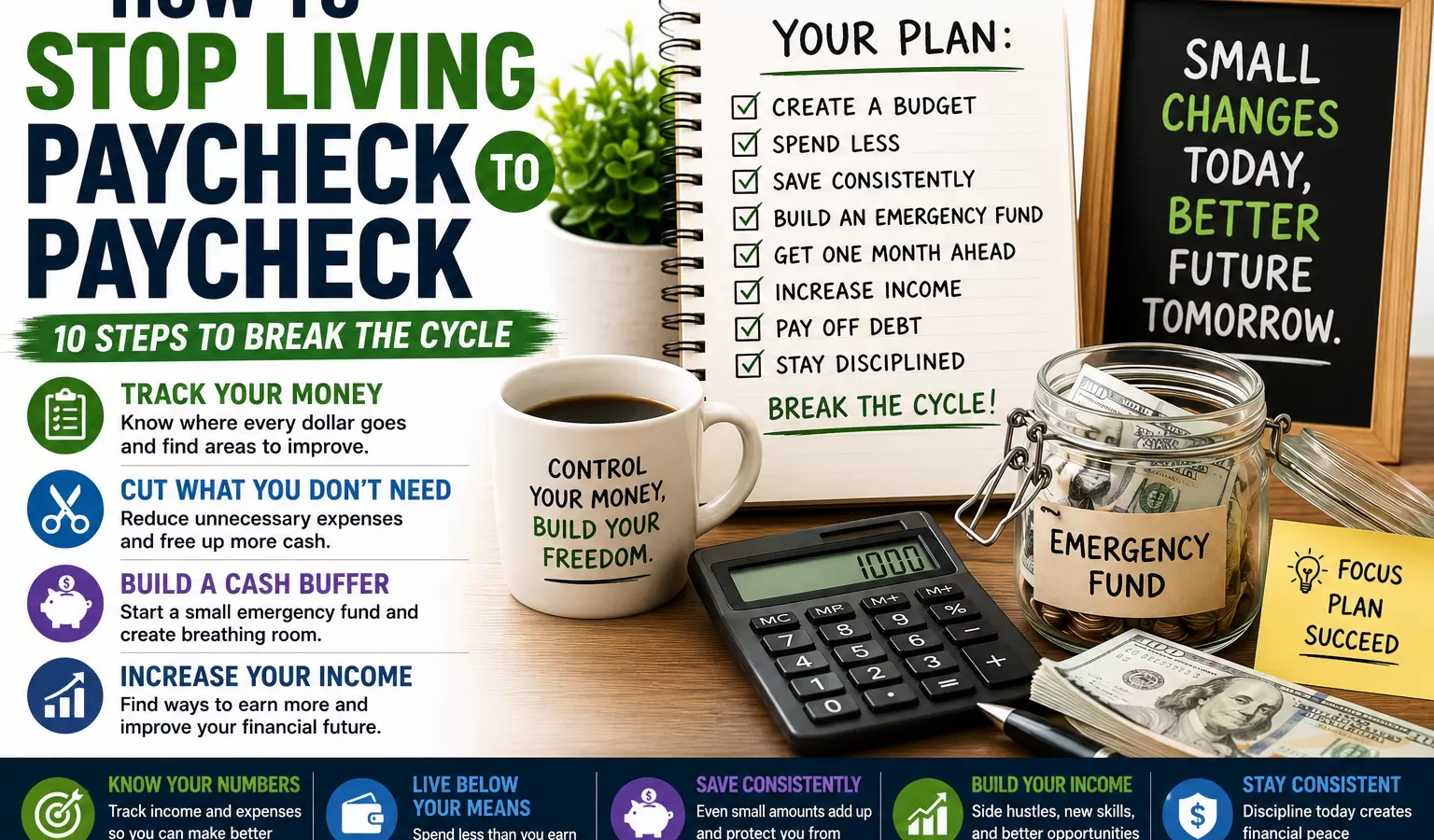
Here are 10 practical steps that can help.
What Does Living Paycheck to Paycheck Mean?
Living paycheck to paycheck generally means that most or all of your regular income is needed to cover expenses before your next paycheck arrives.
There may be little money available for:
- Emergency savings
- Unexpected expenses
- Long-term goals
- Additional debt payments
- Major purchases
That means an unexpected $500 expense could force you to use a credit card, delay another bill or borrow money.
The Consumer Financial Protection Bureau explains that managing cash flow involves paying attention to when money comes in and when expenses go out. Understanding that timing can be especially useful when you regularly run short before your next paycheck.
Step 1: Calculate Exactly Where Your Money Goes
Don’t start by guessing what the problem is.
Use your actual numbers.
Review the previous 30 to 90 days of:
- Bank statements
- Credit-card statements
- Bills
- Cash purchases
- Payment apps
Separate your spending into major categories.
For example:
| Expense | Monthly Amount |
|---|---|
| Rent | $1,400 |
| Groceries | $500 |
| Transportation | $350 |
| Utilities | $220 |
| Insurance | $200 |
| Debt payments | $300 |
| Restaurants | $250 |
| Shopping | $200 |
| Subscriptions | $80 |
| Other | $200 |
| Total | $3,700 |
Suppose your monthly take-home income is:
$3,800
That leaves only:
$100
Now you can see why saving feels difficult.
Your immediate problem isn’t necessarily motivation.
You simply have only $100 of monthly financial margin.
That’s the number you need to improve.
If you haven’t organized your finances yet, start with BriefTop’s How to Make a Budget: A Simple Step-by-Step Guide That Actually Works.
A budget gives you the numbers you need before deciding what to cut or how much you can realistically save.
Step 2: Separate Essential Expenses From Discretionary Spending
Once you’ve tracked your spending, divide expenses into two broad groups.
Essential Expenses
These can include:
- Housing
- Basic groceries
- Utilities
- Essential transportation
- Insurance
- Healthcare
- Necessary childcare
- Minimum required debt payments
Discretionary Expenses
These may include:
- Restaurants
- Food delivery
- Entertainment
- Nonessential shopping
- Vacations
- Premium subscriptions
- Hobbies
- Convenience purchases
This distinction matters because it helps identify the actual problem.
If you’re spending hundreds of dollars every month on discretionary purchases, there may be meaningful opportunities to reduce spending.
But if nearly all your income already goes toward necessities, canceling one streaming subscription probably won’t solve the underlying issue.
Step 3: Find Your Monthly Financial Gap
Use this simple calculation:
Monthly income − Monthly expenses = Financial margin
Suppose you earn:
$4,000
and spend:
$3,900
Your margin is:
$100
Your first objective doesn’t need to be becoming wealthy.
It should be increasing that $100.
For example:
Reduce expenses by $200.
Increase income by $200.
Your monthly margin could increase from:
$100 to $500
That’s an additional:
$400 per month
or:
$4,800 per year
that can potentially be directed toward savings, debt or other financial goals.
This is how breaking the paycheck-to-paycheck cycle begins.
Step 4: Cut Expenses That Produce Meaningful Savings
Don’t start by obsessing over every tiny purchase.
Look first for expenses capable of materially changing your budget.
Review:
- Housing
- Transportation
- Insurance
- Phone plans
- Internet
- Restaurants
- Food delivery
- Subscriptions
- Shopping
- Recurring memberships
Suppose you find:
Unused subscriptions: $45
Restaurant reduction: $100
Cheaper phone plan: $35
Shopping reduction: $75
Total:
$255 per month
That’s:
$3,060 per year
without eliminating every enjoyable purchase.
For more ideas, see BriefTop’s How to Save Money Fast: 15 Practical Ways That Actually Work.
The goal isn’t to remove everything enjoyable from your life. It’s to identify spending that matters less to you than creating financial stability.
Step 5: Create a Small Cash Buffer
When your checking account regularly approaches $0 before payday, even a small timing problem can become stressful.
Start by creating a small buffer.
Your milestones could be:
$100
Then:
$250
Then:
$500
This money can create breathing room between bills and paydays.
It doesn’t necessarily replace a complete emergency fund.
Think of it as the first layer of financial protection.
Step 6: Build Your First $1,000
Once you’ve created a little breathing room, begin building emergency savings.
Your first larger target could be:
$500
Then:
$1,000
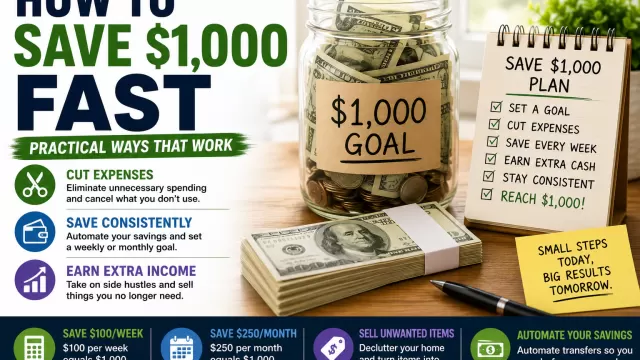
BriefTop’s How to Save $1,000 Fast: A Realistic Step-by-Step Plan explains how to break that goal into manageable weekly or monthly targets.
For example:
$50 per week = $1,000 in 20 weeks
$100 per week = $1,000 in 10 weeks
$250 per month = $1,000 in four months
You don’t need to reach $1,000 immediately.
The objective is to gradually build enough cash that every unexpected expense doesn’t automatically become new debt.
Step 7: Automate a Small Amount Every Payday
Waiting until the end of the month and saving whatever remains often doesn’t work.
There may be nothing left.
Instead, consider transferring a predetermined amount to savings when you’re paid.
Even:
$20 per paycheck
can establish the habit.
If you’re paid every two weeks:
$20 × 26 = $520 per year
Increase the amount when your financial situation improves.
The FDIC notes that automatic transfers can help consumers save before they spend and build savings consistently over time.
Step 8: Work Toward Getting One Paycheck Ahead
This can be an important milestone when trying to stop living paycheck to paycheck.
Instead of depending entirely on Friday’s paycheck to pay the next bill, gradually build enough cash that upcoming expenses can be covered with money you already have.
Don’t expect to accomplish this immediately.
Start with:
$250
Then:
$500
Then:
$1,000
Eventually, you can work toward having one month of essential expenses available.
Suppose your essential monthly expenses are:
$3,000
Your progression might look like:
$250 → $500 → $1,000 → $1,500 → $3,000
Each milestone creates additional flexibility.
For a deeper explanation of how much emergency savings you may eventually want, read BriefTop’s Emergency Fund: How Much Should You Have?.
Step 9: Increase Income When Cutting Isn’t Enough
There’s a mathematical limit to cutting expenses.
You can’t reduce rent to zero.
You still need food.
You still need transportation.
If essential expenses already consume nearly all your income, increasing income may be necessary to create meaningful financial margin.
Depending on your circumstances, possibilities could include:
- Overtime
- Additional work hours
- Freelance work
- Part-time work
- Selling a service
- Tutoring
- Seasonal work
- Developing a higher-paying skill
- Pursuing a better-paying position
Suppose additional work produces:
$400 per month after related expenses
If you keep your existing lifestyle roughly unchanged, that creates:
$4,800 per year
of additional financial capacity.
The important part is preventing every increase in income from immediately becoming an equal increase in spending.
Step 10: Give New Money a Job Before You Receive It
Raises, bonuses and tax refunds can disappear surprisingly quickly.
Decide what you’ll do with additional money before it arrives.
Suppose your take-home pay increases by:
$300 per month
You might decide:
$150 → savings
$100 → debt
$50 → additional spending
You still enjoy part of the raise.
But you’re also improving your financial position by:
$250 per month
or:
$3,000 per year
This helps prevent lifestyle inflation from keeping you in the same financial cycle even as your income increases.
How to Stop Living Paycheck to Paycheck on a Low Income
This situation deserves special attention.
If your income is low relative to essential expenses, generic advice like “stop buying coffee” may have very little impact.
Start by calculating your essential-expense ratio.
Suppose you earn:
$2,500 per month
and necessities cost:
$2,300
That’s:
92% of your income
before discretionary spending.
Your problem isn’t primarily entertainment spending.
You have a very small income-to-expense margin.
Your strategy may need to focus more heavily on:
- Reducing major fixed expenses when realistically possible
- Increasing income
- Avoiding unnecessary fees
- Accessing legitimate assistance programs for which you qualify
- Building savings slowly
- Avoiding unnecessary high-cost debt
Don’t compare your savings progress with someone whose income leaves thousands of dollars available every month.
Your goal is improvement relative to your own financial situation.
How Much Should You Save From Each Paycheck?
There’s no universal percentage that works for everyone.
If 20% is realistic, that’s excellent.
If 10% is realistic, start there.
If 5% is realistic, start there.
Even a smaller percentage can help establish the habit.
For example, with a take-home paycheck of:
$1,500
5% = $75
10% = $150
20% = $300
BriefTop’s How Much Should I Save Each Month? A Simple Guide for Every Income provides examples across different income levels and explains why the same savings percentage doesn’t work for everyone.
Can the 50/30/20 Budget Rule Help?
Possibly.
The 50/30/20 framework generally divides take-home income into approximately:
50% for needs
30% for wants
20% for savings and financial goals
It’s useful as a reference point.
But if you’re currently living paycheck to paycheck, necessities may already consume considerably more than 50% of your income.
That doesn’t mean you’ve automatically failed at budgeting.
Use the framework to understand your finances rather than treating it as an inflexible requirement.
BriefTop’s 50/30/20 Budget Rule: How It Works With Real Examples explains the system and how the percentages may need to change depending on your circumstances.
What Should You Do With Your First Extra $100?
Suppose you’ve made changes and now have an extra:
$100 per month
Don’t immediately increase your lifestyle by $100.
Use the money to create breathing room.
For example:
Month 1
Savings: $100
Month 2
Savings balance: $200
Month 5
Savings balance: $500
Month 10
Savings balance: $1,000
After reaching your first milestone, decide whether to continue building emergency savings, address expensive debt or divide your money among several financial goals.
How Long Does It Take to Stop Living Paycheck to Paycheck?
There’s no universal timeline.
Someone who needs to reduce $200 of discretionary spending may create breathing room relatively quickly.
Someone whose essential expenses exceed their income faces a more difficult structural problem.
Instead of measuring success only by time, track milestones.
Milestone 1: Stop overdrawing your account.
Milestone 2: Create a $100–$500 cash buffer.
Milestone 3: Save your first $1,000.
Milestone 4: Build one month of essential expenses.
Milestone 5: Continue strengthening emergency savings and other financial goals.
Each milestone increases your financial resilience.
Common Mistakes to Avoid
Trying to Change Everything at Once
A financial plan that feels like punishment probably won’t last.
Focus on changes you can maintain.
Setting an Impossible Savings Goal
Saving 20% sounds great until it causes you to miss essential bills.
Choose an amount appropriate for your circumstances.
Ignoring Major Expenses
Canceling a $10 subscription won’t solve a $700 monthly deficit.
Always look at the largest numbers in your budget.
Spending Every Raise
Higher income doesn’t automatically create financial stability if your spending rises at the same pace.
Treating Credit Cards as an Emergency Fund
Borrowing can turn a temporary expense into a longer-term financial obligation, particularly when interest charges accumulate.
Giving Up After One Bad Month
Car repairs, medical expenses and other unexpected costs happen.
Adjust your plan and continue.
Frequently Asked Questions
How do I stop living paycheck to paycheck?
Start by tracking all income and expenses, calculating your monthly financial margin, reducing meaningful discretionary expenses and building a small cash buffer. If essential expenses consume nearly all your income, increasing income or reducing major fixed costs may also be necessary.
Is living paycheck to paycheck always caused by overspending?
No. Overspending can contribute, but high housing costs, low income, debt, healthcare expenses, childcare and other necessities can also leave households with very little financial margin.
How much money should I have left after bills?
There’s no universal dollar amount. The goal is to gradually create enough financial margin to save, prepare for unexpected expenses and work toward your other goals.
Should I save if I’m living paycheck to paycheck?
If possible, even a small amount can help create a financial cushion. Start with an amount that doesn’t prevent you from covering necessities.
How can I get one month ahead on bills?
Calculate one month of essential expenses and build toward that amount gradually. Start with smaller milestones such as $250, $500 and $1,000 rather than expecting to save the entire amount immediately.
The Bottom Line
Learning how to stop living paycheck to paycheck isn’t about becoming perfect with money.
It’s about creating financial margin.
Know where your money goes.
Reduce expenses that aren’t providing enough value.
Build a small buffer.
Save something from each paycheck when possible.
Increase income if your essential expenses leave no room.
Then protect the progress you’ve made.
Your first goal doesn’t need to be $100,000.
It might simply be reaching the next payday with money still in your account.
Then saving:
$500
Then:
$1,000
Then:
one month of essential expenses
Breaking the paycheck-to-paycheck cycle happens one layer of financial breathing room at a time.
Editorial Note: This article provides general educational information and does not constitute individualized financial, investment, tax or legal advice.
Trusted Sources
Consumer Financial Protection Bureau — An Essential Guide to Building an Emergency Fund
FDIC — Starting Small Can Lead to Big Savings
Related BriefTop Guides
How Much Should I Save Each Month?