Creating a budget can feel complicated.
How much should go toward rent?
How much can you spend on entertainment?
How much should you save?
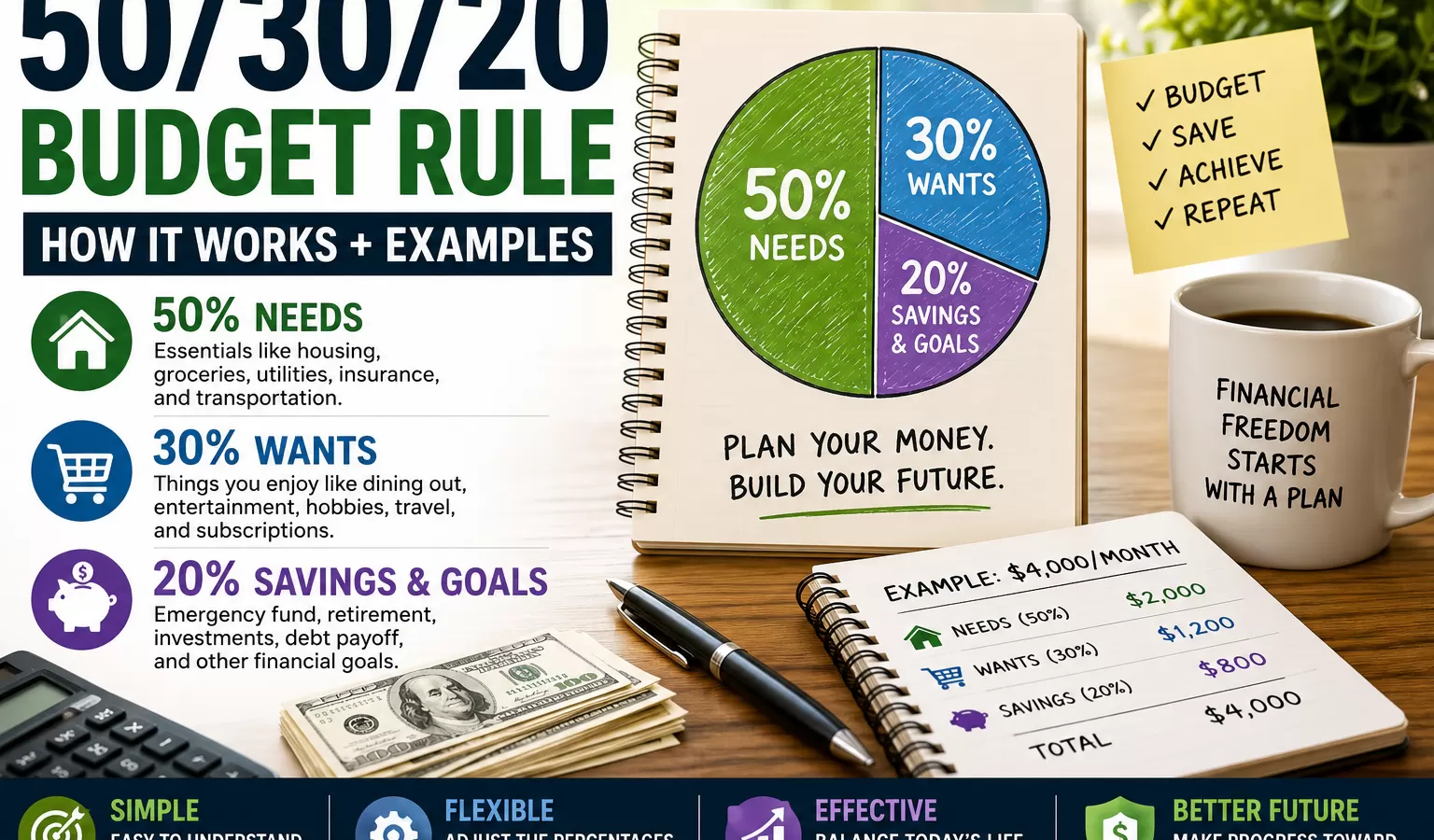
The 50/30/20 budget rule attempts to answer those questions with three simple numbers:
50% for needs
30% for wants
20% for savings and financial goals
Instead of tracking dozens of tiny spending categories, the method divides your take-home income into three broad buckets.
It’s simple, flexible and easy to understand.
But there’s an important detail:
The 50/30/20 rule is a guideline, not a financial law.
Your housing costs, income, family size, debt and location can make the exact percentages difficult — or even unrealistic — to follow.
Here’s how the 50/30/20 budget works, how to calculate your numbers and how to adjust the rule when real life doesn’t fit perfectly into three percentages.
What Is the 50/30/20 Budget Rule?
The basic formula is:
50% — Needs
Half of your take-home income goes toward essential expenses.
30% — Wants
Up to 30% goes toward discretionary spending and things that improve your lifestyle but aren’t essential for basic living.
20% — Savings and Financial Goals
The remaining 20% goes toward savings and additional debt repayment.
The Consumer Financial Protection Bureau has presented the 50/20/30 approach as a common rule of thumb for managing spending.
The CFPB also emphasizes that consumers can create their own spending guidelines when the standard percentages don’t work for their financial circumstances.
If your essential needs already consume most of your income, our guide on how to stop living paycheck to paycheck explains practical steps for creating more financial breathing room before trying to follow a strict budgeting percentage.
See the Consumer Financial Protection Bureau’s budgeting resources
Should You Use Gross or Take-Home Income?
For a simple 50/30/20 budget, start with your monthly take-home pay.
That’s generally the money reaching you after payroll deductions rather than your headline annual salary.
For example:
Annual salary: $60,000
That doesn’t automatically mean you should calculate your budget using:
$60,000 ÷ 12 = $5,000
Your actual available monthly income may be lower after taxes and other payroll deductions.
Instead, look at what you actually receive.
Suppose your monthly take-home income is:
$4,000
Your starting 50/30/20 budget becomes:
| Category | Percentage | Monthly Amount |
|---|---|---|
| Needs | 50% | $2,000 |
| Wants | 30% | $1,200 |
| Savings/Goals | 20% | $800 |
| Total | 100% | $4,000 |
That’s the basic framework.
Now let’s look at what belongs in each category.
What Counts as Needs in the 50/30/20 Rule?
Needs are expenses that are necessary for basic living and important financial obligations.
They can include:
- Rent or mortgage
- Basic groceries
- Electricity
- Water
- Essential transportation
- Insurance
- Healthcare
- Necessary medications
- Childcare needed for work
- Minimum required debt payments
- Essential phone service
A useful question is:
Would failing to pay for this create a serious problem?
If the answer is yes, you’re probably looking at a need.
The CFPB identifies expenses such as mortgage or rent, utilities, healthcare and childcare as typical needs or obligations when evaluating spending.
What Counts as Wants?
Wants are things you choose to spend money on that aren’t essential for basic living.
Examples can include:
- Restaurant meals
- Food delivery
- Vacations
- Streaming subscriptions
- Concerts
- Premium clothing
- Entertainment
- Hobbies
- Nonessential shopping
- Upgraded electronics
- Luxury services
This doesn’t mean wants are bad.
Money is also meant to support a life you enjoy.
The purpose of the 30% category is to establish a boundary so lifestyle spending doesn’t consume money intended for necessities and future goals.
Needs vs. Wants Can Get Complicated
Some expenses can be either a need or a want depending on the circumstances.
Take transportation.
If you need a reliable car to get to work, transportation is a need.
But choosing a significantly more expensive luxury vehicle when an affordable vehicle would meet the same transportation requirement introduces a discretionary component.
Food provides another example.
Groceries are generally a need.
A $150 restaurant dinner is generally a want.
Housing can also blur the line.
You need somewhere to live.
But the difference between basic housing and choosing a considerably more expensive property can involve both needs and lifestyle preferences.
Don’t obsess over categorizing every dollar perfectly.
The goal is to understand the difference between essential spending and discretionary spending.
What Goes Into the 20% Category?
The final 20% is generally dedicated to improving your future financial position.
That can include:
- Emergency savings
- Retirement savings
- Additional debt payments
- Saving for a home
- Education savings
- Other long-term financial goals
For example, if your 20% category equals $800 per month, you might divide it like this:
Emergency fund: $300
Retirement: $300
Additional debt payment: $200
Total:
$800
If you don’t yet have emergency savings, building a financial cushion may be an important early priority.
BriefTop’s Emergency Fund: How Much Should You Have? explains how to calculate a target based on your essential expenses.
50/30/20 Budget Example With $3,000 a Month
Suppose your monthly take-home income is:
$3,000
The calculation is:
Needs — 50%
$3,000 × 0.50 = $1,500
Wants — 30%
$3,000 × 0.30 = $900
Savings/Goals — 20%
$3,000 × 0.20 = $600
Your budget would look like this:
| Category | Monthly Amount |
|---|---|
| Needs | $1,500 |
| Wants | $900 |
| Savings/Goals | $600 |
| Total | $3,000 |
If you saved or directed the full $600 toward financial goals every month, that would equal:
$7,200 per year
before considering investment returns or interest.
50/30/20 Budget Example With $4,000 a Month
Monthly take-home income:
$4,000
Your targets become:
| Category | Percentage | Amount |
|---|---|---|
| Needs | 50% | $2,000 |
| Wants | 30% | $1,200 |
| Savings/Goals | 20% | $800 |
| Total | 100% | $4,000 |
A possible real-world breakdown might be:
Needs — $2,000
Rent: $1,100
Groceries: $350
Utilities: $150
Transportation: $250
Insurance/healthcare: $150
Total: $2,000
Wants — $1,200
Restaurants: $250
Entertainment: $150
Shopping: $250
Subscriptions: $50
Travel fund: $250
Hobbies/other wants: $250
Total: $1,200
Savings and Goals — $800
Emergency savings: $300
Retirement/investing: $300
Additional debt payment: $200
Total: $800
Real budgets rarely look this neat, but the example demonstrates how the framework works.
50/30/20 Budget Example With $5,000 a Month
Monthly take-home income:
$5,000
The targets are:
Needs: $2,500
Wants: $1,500
Savings/Goals: $1,000
That means potentially directing:
$12,000 per year
toward savings and other financial goals if you consistently allocate $1,000 per month.
50/30/20 Budget Example With $6,000 a Month
Monthly take-home income:
$6,000
The breakdown becomes:
| Category | Percentage | Monthly Amount |
|---|---|---|
| Needs | 50% | $3,000 |
| Wants | 30% | $1,800 |
| Savings/Goals | 20% | $1,200 |
| Total | 100% | $6,000 |
Annual amount directed toward the 20% category:
$1,200 × 12 = $14,400
Again, this is a framework rather than a requirement.
Quick 50/30/20 Calculator
You don’t need a special calculator.
Take your monthly take-home income and multiply it by:
Needs: Income × 0.50
Wants: Income × 0.30
Savings/Goals: Income × 0.20
Here are several examples:
| Monthly Take-Home Pay | Needs 50% | Wants 30% | Savings 20% |
|---|---|---|---|
| $2,000 | $1,000 | $600 | $400 |
| $2,500 | $1,250 | $750 | $500 |
| $3,000 | $1,500 | $900 | $600 |
| $3,500 | $1,750 | $1,050 | $700 |
| $4,000 | $2,000 | $1,200 | $800 |
| $4,500 | $2,250 | $1,350 | $900 |
| $5,000 | $2,500 | $1,500 | $1,000 |
| $6,000 | $3,000 | $1,800 | $1,200 |
| $7,500 | $3,750 | $2,250 | $1,500 |
| $10,000 | $5,000 | $3,000 | $2,000 |
You can use this table as a starting point and then adjust the percentages based on your actual financial circumstances.
What If Your Needs Are More Than 50%?
This is where the 50/30/20 rule encounters real life.
Imagine you earn $3,000 per month after deductions.
According to the rule, needs should be approximately:
$1,500
But suppose your actual necessities are:
Rent: $1,300
Groceries: $400
Transportation: $300
Utilities: $200
Insurance: $150
Total:
$2,350
Your needs represent approximately 78% of your take-home income.
You can’t magically reduce them to $1,500 because a budgeting formula says so.
The CFPB itself notes that not everyone can follow a standard budgeting rule and encourages people to develop guidelines that work for their circumstances.
Instead of abandoning budgeting completely, adjust the percentages.
For example:
75% needs
10% wants
15% savings/goals
Or whatever realistically fits your situation.
The important principle is allocating your money intentionally.
What If Your Rent Alone Is Almost 50%?
Housing is one reason the 50/30/20 budget can be difficult in expensive areas.
If your rent already consumes 40% or 50% of your take-home income, fitting groceries, transportation, insurance and utilities into the remaining portion of the needs category may be impossible.
You have several possible responses:
Reduce discretionary spending.
Look for ways to lower other fixed expenses.
Increase income.
Consider less expensive housing when realistically possible.
Or simply use different percentages.
A budgeting method should help you manage money.
It shouldn’t make you feel like you’ve failed because your local housing market doesn’t fit a formula.
What If You Have a Lot of Debt?
Debt creates another important question.
Where should debt payments go?
A useful distinction is between the minimum required payment and additional payments made specifically to eliminate debt faster.
Minimum payments are financial obligations and can generally be treated as needs.
Extra payments can be considered part of your 20% financial-goals category.
For example:
Credit card minimum payment:
$100
Extra payment:
$300
The $100 is an obligation.
The additional $300 is money intentionally directed toward improving your financial position.
Can You Change the 50/30/20 Percentages?
Absolutely.
Consider 50/30/20 a starting framework.
Your budget might eventually look like:
60/20/20
or:
70/10/20
or:
50/20/30
Someone aggressively saving for a home might use:
50% needs
15% wants
35% savings
Someone temporarily dealing with high essential expenses might use:
70% needs
20% wants
10% savings
The percentages should support your goals rather than control them.
50/30/20 vs. 70/20/10 Budget
Another budgeting framework is sometimes described as 70/20/10.
One possible version allocates:
70% — living expenses
20% — savings/investments
10% — giving or other financial priorities
Different versions exist, which demonstrates an important point:
There isn’t one universal budgeting formula.
The best framework is one you can realistically maintain.
Advantages of the 50/30/20 Rule
The method has several practical advantages.
It’s Simple
You only have three major categories.
It Includes Enjoyment
You’re not expected to eliminate all discretionary spending.
It Prioritizes the Future
Savings and financial goals receive their own category instead of whatever happens to remain at the end of the month.
It’s Easy to Adjust
You can change the percentages while maintaining the same general structure.
It Helps Identify Problems
If necessities consume 80% of your income, the calculation immediately reveals how little flexibility remains.
Disadvantages of the 50/30/20 Rule
The method isn’t perfect.
Housing Costs Vary Dramatically
50% for all necessities may be difficult in expensive areas.
Income Levels Matter
Someone with a very low income may need nearly everything for essentials.
It Can Oversimplify Debt
Someone carrying expensive debt may need a more aggressive repayment strategy.
It Doesn’t Capture Every Goal
Retirement, emergency savings, education, home purchases and debt can all compete for the same 20%.
Categories Can Be Subjective
One person’s need can be another person’s want.
That’s why the method works best as a framework rather than a rigid rule.
How to Start Using the 50/30/20 Rule
Step 1: Calculate Your Take-Home Income
Determine how much money you actually have available each month.
Step 2: Track Your Current Spending
Review several months of bank and credit-card statements.
Don’t guess.
Use your actual transactions.
Step 3: Separate Needs From Wants
Identify essential obligations first.
Then identify discretionary spending.
Step 4: Calculate Your Target Percentages
Multiply your monthly take-home income by:
0.50
0.30
0.20
Step 5: Compare Targets With Reality
Your actual spending probably won’t match perfectly.
That’s okay.
The difference shows you where adjustments may be possible.
Step 6: Create Your Personal Version
Modify the percentages if necessary.
Step 7: Automate Your Financial Goals
Once you’ve chosen your savings amount, consider automatically transferring it after payday.
How the 50/30/20 Rule Can Help You Save Money
The rule gives savings a defined place in your budget.
Instead of saying:
“I’ll save whatever is left.”
you’re saying:
“I’m intentionally directing part of my income toward my future.”
That’s a major difference.
If reducing expenses is currently your biggest challenge, BriefTop’s How to Save Money Fast: 15 Practical Ways That Actually Work provides strategies for finding additional room in your monthly budget.
Start With a Real Budget First
Before trying to force your spending into 50/30/20, understand what you’re currently doing with your money.
Track:
Income.
Bills.
Groceries.
Transportation.
Subscriptions.
Shopping.
Restaurants.
Debt.
Savings.
Then compare your current percentages with the guideline.
If you haven’t done this yet, use BriefTop’s How to Make a Budget: A Simple Step-by-Step Guide That Actually Works.
Frequently Asked Questions
What is the 50/30/20 rule?
It’s a budgeting guideline that generally divides take-home income into 50% for needs, 30% for wants and 20% for savings and financial goals.
Does the 50/30/20 rule use gross or net income?
For the simple version described here, use your monthly take-home or net income — the money available to you after applicable payroll deductions.
Does rent go in the 50% category?
Yes. Housing is generally considered a need.
Are groceries a need or a want?
Basic groceries are generally a need. Restaurant meals and food delivery are typically more discretionary and can generally be treated as wants.
Where do credit card payments go?
Minimum required payments can be treated as obligations within needs. Additional payments intended to eliminate debt faster can be included among financial goals.
Is the 50/30/20 rule realistic?
It can be useful for many people, but it won’t fit every household. High housing costs, low income, dependents, debt and other circumstances can make different percentages more realistic.
What if I can’t save 20% of my income?
Start with an amount you can consistently manage.
Saving 5% consistently can be more useful than setting an unrealistic 20% target and repeatedly abandoning it.
As your income or expenses change, you can gradually increase the percentage.
The Bottom Line
The 50/30/20 budget rule provides a simple starting point:
50% needs
30% wants
20% savings and financial goals
But the most important word is:
Starting.
You don’t need to hit every percentage perfectly.
Your real objective is to understand where your money goes, cover your necessities, control discretionary spending and consistently direct something toward your future.
Use 50/30/20 as a framework.
Then adjust it to fit your actual life.
A budget you can consistently follow is more valuable than a mathematically perfect budget you abandon after two weeks.
Editorial Note: This article provides general educational information and does not constitute individualized financial, investment, tax or legal advice.
Trusted Sources
Consumer Financial Protection Bureau (CFPB): Budgeting education, 50/30/20 budgeting materials, spending guidance and needs-versus-wants resources.
BriefTop: How to Make a Budget, How to Save Money Fast and Emergency Fund guides.