You know you should save money.
But exactly how much should you save each month?
$100?
$500?
20% of your paycheck?
Half your income?
Search for an answer and you’ll encounter plenty of percentages and financial rules.
The problem is that everyone’s financial situation is different.
Someone earning $3,000 per month while paying high rent doesn’t have the same savings capacity as someone earning $8,000 with relatively low expenses.
That’s why the best monthly savings target isn’t simply a universal dollar amount.
It’s an amount that balances your income, essential expenses, debt and financial goals.
Here’s how to calculate a realistic number.
How Much Should I Save Each Month?
A commonly used starting point is to consider directing around 20% of take-home income toward savings and other financial goals.
This is the savings portion of the popular 50/30/20 budgeting framework:
50% — Needs
30% — Wants
20% — Savings and financial goals
But 20% isn’t a requirement.
Some people may only be able to save 5% right now.
Others may be able to save 30%, 40% or more.
A better question is:
How much can I consistently save while still covering my essential expenses?
Consistency matters more than choosing an impressive percentage that you can’t maintain.
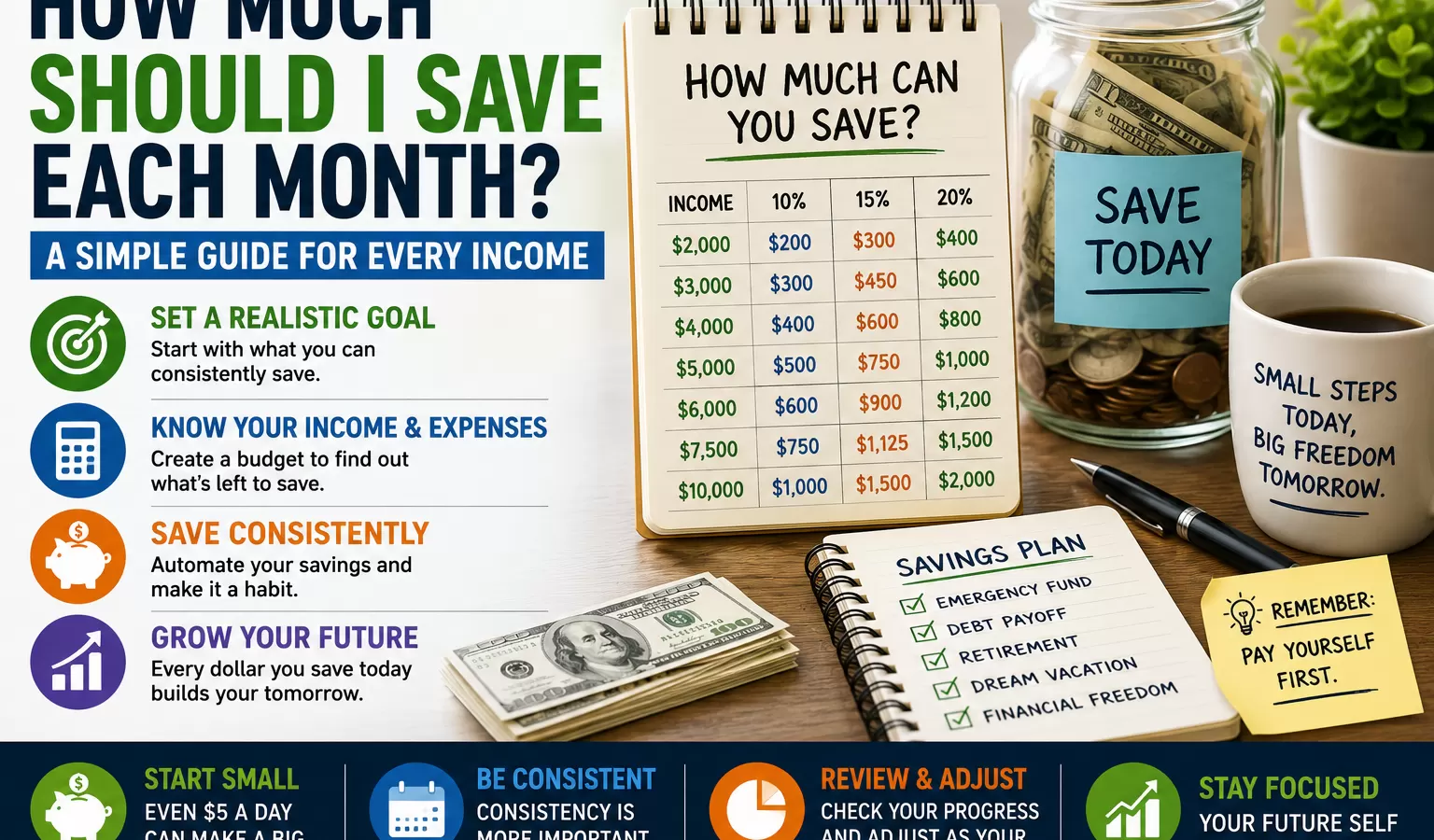
Monthly Savings by Income
Here’s what different savings rates look like at several monthly take-home income levels:
| Monthly Take-Home Income | 5% | 10% | 15% | 20% |
|---|---|---|---|---|
| $2,000 | $100 | $200 | $300 | $400 |
| $2,500 | $125 | $250 | $375 | $500 |
| $3,000 | $150 | $300 | $450 | $600 |
| $3,500 | $175 | $350 | $525 | $700 |
| $4,000 | $200 | $400 | $600 | $800 |
| $5,000 | $250 | $500 | $750 | $1,000 |
| $6,000 | $300 | $600 | $900 | $1,200 |
| $7,500 | $375 | $750 | $1,125 | $1,500 |
| $10,000 | $500 | $1,000 | $1,500 | $2,000 |
These numbers aren’t targets everyone must reach.
They’re simply useful reference points.
If building even a starter emergency fund feels difficult because nearly every paycheck goes toward bills, our guide on how to stop living paycheck to paycheck can help you create more room in your budget.
How Much Should You Save From a $3,000 Monthly Income?
Suppose your take-home pay is:
$3,000 per month
Saving 20% would equal:
$3,000 × 0.20 = $600 per month
Over one year:
$600 × 12 = $7,200
But perhaps $600 isn’t realistic.
Saving 10% would be:
$300 per month
Over one year:
$3,600
Even 5% would produce:
$150 per month
or:
$1,800 per year
The important point is that a smaller consistent savings habit can still produce meaningful progress.
How Much Should You Save From a $4,000 Monthly Income?
At $4,000 per month:
5% = $200
10% = $400
15% = $600
20% = $800
Saving $800 per month would equal:
$9,600 per year
Saving $400 per month would equal:
$4,800 per year
Both represent financial progress.
How Much Should You Save From a $5,000 Monthly Income?
With monthly take-home pay of $5,000:
5% = $250
10% = $500
15% = $750
20% = $1,000
At a 20% savings rate:
$1,000 × 12 = $12,000 per year
At 10%:
$500 × 12 = $6,000 per year
Again, the appropriate amount depends on what the rest of your budget looks like.
Should Everyone Save 20%?
No.
The 20% figure is useful as a reference point, but personal finances rarely fit perfectly into a formula.
Imagine two people earning the same amount.
Both take home:
$4,000 per month
Person A has essential monthly expenses of:
$2,000
Person B has essential monthly expenses of:
$3,400
Expecting both people to save $800 per month ignores their very different circumstances.
If you can save 20% without struggling to cover essential expenses, that’s a strong target.
If you can’t, start lower.
You can increase your savings rate as your finances improve.
For a deeper explanation of the percentages, read BriefTop’s 50/30/20 Budget Rule: How It Works With Real Examples.
Start With Your Actual Budget
Before choosing a savings percentage, determine where your money currently goes.
Calculate:
Monthly take-home income
minus:
Essential expenses
minus:
Debt obligations
minus:
reasonable discretionary spending
What’s left?
That’s your current savings capacity.
For example:
Monthly take-home income: $4,000
Essential expenses: $2,300
Debt payments: $300
Discretionary spending: $700
Remaining:
$700
Your realistic starting savings target might therefore be around $700 rather than automatically forcing yourself to save $800 because a formula recommends 20%.
If you haven’t calculated your monthly expenses yet, start with BriefTop’s How to Make a Budget: A Simple Step-by-Step Guide That Actually Works.
Start With a Percentage You Can Maintain
If you’re currently saving nothing, jumping immediately to 20% can feel overwhelming.
Try progressing gradually.
For example:
Months 1–2: Save 5%
Months 3–4: Save 7%
Months 5–6: Save 10%
Then continue increasing the percentage when your finances allow.
Building the habit is often more important than immediately reaching a particular percentage.
How Much Should You Save Per Paycheck?
You can also calculate savings based on each paycheck.
Suppose your take-home paycheck is:
$2,000
If you want to save 10%:
$2,000 × 0.10 = $200
At 15%:
$300
At 20%:
$400
If you’re paid twice monthly and save $400 from each paycheck, you’re saving approximately:
$800 per month
The advantage of saving per paycheck is that the money can be moved before you have an opportunity to spend it.
Automate Your Monthly Savings
One of the simplest ways to save consistently is to automate the process.
Instead of waiting until the end of the month and hoping money remains, schedule a transfer shortly after payday.
For example:
Paycheck: Friday
Automatic transfer: Saturday
Amount: $200
The Consumer Financial Protection Bureau includes recurring savings contributions when helping consumers build realistic monthly budgets and savings plans.
Automation turns saving from a monthly decision into a routine.
Where Should Your Monthly Savings Go?
“Saving money” isn’t really one goal.
Your savings may need to accomplish several different things.
For example:
Emergency Fund
Money for unexpected expenses or income disruptions.
Retirement
Long-term money intended for your future.
Short-Term Goals
Vacation, electronics, furniture or other planned purchases.
Medium-Term Goals
Vehicle replacement, education or other significant expenses.
Home Down Payment
Money specifically reserved for purchasing a home.
Additional Debt Payments
Depending on your situation, part of the money allocated toward financial goals may be used to reduce expensive debt.
Giving every savings dollar a purpose makes it easier to understand whether you’re actually making progress.
Build Emergency Savings First
If you currently have no financial cushion, emergency savings can be an important early priority.
Imagine saving $500 per month.
Instead of dividing that amount among five different goals immediately, you might initially direct a larger share toward establishing an emergency fund.
For example:
Emergency fund: $400
Other goal: $100
Once your emergency savings reach an appropriate level, you can redirect some of the monthly contribution toward other priorities.
BriefTop’s Emergency Fund: How Much Should You Have? explains how to calculate a target based on essential monthly expenses.
How Much Should You Save for an Emergency Fund Each Month?
There’s no required monthly amount.
Start with your target and desired timeline.
Suppose your initial emergency fund target is:
$3,000
You want to reach it within:
12 months
Calculation:
$3,000 ÷ 12 = $250 per month
If you want to reach the same target in six months:
$3,000 ÷ 6 = $500 per month
This simple calculation works for many savings goals:
Goal amount ÷ Number of months = Monthly savings target
The CFPB uses this same basic approach in its savings-planning materials.
Example: Saving $1,000
Goal:
$1,000
Timeline:
10 months
Monthly savings required:
$1,000 ÷ 10 = $100
That’s considerably less intimidating than thinking only about the $1,000 total.
How Much Should You Save Each Year?
Your annual savings depend on your monthly contribution.
| Monthly Savings | Annual Savings |
|---|---|
| $50 | $600 |
| $100 | $1,200 |
| $200 | $2,400 |
| $300 | $3,600 |
| $500 | $6,000 |
| $750 | $9,000 |
| $1,000 | $12,000 |
| $1,500 | $18,000 |
| $2,000 | $24,000 |
This demonstrates why consistent monthly saving matters.
You don’t necessarily need a huge one-time deposit.
Regular contributions accumulate.
Is Saving $100 a Month Good?
If $100 is what you can realistically save right now, yes.
$100 per month becomes:
$1,200 per year
Over five years, contributions alone would equal:
$6,000
before considering any applicable interest or investment returns.
More importantly, you’ve created a savings habit.
As your income increases or expenses decrease, you can raise the amount.
Is Saving $500 a Month Good?
Saving $500 every month equals:
$6,000 per year
That’s enough to make meaningful progress toward an emergency fund or another major financial goal.
Whether $500 represents an aggressive or modest savings rate depends on your income.
For someone taking home $2,500 monthly, it’s 20%.
For someone taking home $10,000, it’s 5%.
That’s why percentages can provide useful context.
Is Saving $1,000 a Month Good?
$1,000 per month equals:
$12,000 per year
Again, compare the number with your income and goals.
If saving $1,000 requires missing essential bills, the target isn’t sustainable.
If you can comfortably save $1,000 while meeting your obligations and maintaining a reasonable lifestyle, it can significantly accelerate your financial goals.
What If You Can’t Save Anything Right Now?
Don’t assume you’ve failed.
First determine why there’s no money available.
Track your spending and separate expenses into:
Essential
and
Discretionary
Look for expenses that can realistically be reduced.
That could include:
- Unused subscriptions
- Restaurant spending
- Delivery fees
- Nonessential shopping
- Expensive service plans
- Avoidable fees
- Other recurring costs
BriefTop’s How to Save Money Fast: 15 Practical Ways That Actually Work provides a step-by-step list of places to look.
If your essential expenses already consume all of your income, however, cutting discretionary spending may not solve the problem.
If most of your income is already going toward essential expenses, read our step-by-step guide on how to stop living paycheck to paycheck to learn how to create more financial breathing room.
Increasing income or obtaining appropriate assistance may become more important.
Increase Your Savings Rate When Your Income Increases
One of the easiest times to increase savings is when you receive more money.
Suppose your take-home income increases by:
$400 per month
Instead of allowing the entire $400 to become additional lifestyle spending, you could automatically save $200.
You still have:
$200 more each month to spend
while also increasing annual savings by:
$200 × 12 = $2,400
This can help prevent lifestyle inflation from absorbing every raise.
Use Unexpected Money Strategically
Occasional income can accelerate your savings.
Examples include:
- Tax refunds
- Bonuses
- Overtime
- Gifts
- Freelance income
- Cash-back rewards
- Money from selling unused items
You don’t necessarily have to save all of it.
You might decide beforehand that:
50% goes toward savings
and:
50% can be spent or used elsewhere
Having the rule before the money arrives makes it less likely that the entire amount disappears.
Review Your Savings Goal Regularly
Your ideal savings amount can change.
Review it when:
- Your income increases
- Your rent changes
- You pay off debt
- You have a child
- You purchase a home
- Your employment changes
- You reach an important savings goal
- Your essential expenses change significantly
A monthly savings target that made sense two years ago may no longer fit your current finances.
Frequently Asked Questions
What percentage of my income should I save?
20% is a commonly used reference point under the 50/30/20 framework, but it isn’t appropriate for everyone. Your actual savings rate should account for income, essential expenses, debt and financial goals.
Is saving 10% of my income enough?
Saving 10% consistently can represent meaningful progress. Whether it’s sufficient for your long-term goals depends on your circumstances, timeline and other financial resources.
How much should I save from each paycheck?
Choose your desired savings percentage and multiply it by your take-home paycheck. For example, 10% of a $2,000 paycheck is $200.
Should I save money every month?
Regular monthly or paycheck-based saving can make progress easier to track and can help turn saving into a habit.
Should I save money if I have debt?
The answer depends on the type and cost of your debt and your financial circumstances. Maintaining some emergency savings can help prevent unexpected expenses from creating additional debt, while high-cost debt may also deserve priority.
Where should I keep my savings?
The appropriate location depends on the goal. Emergency money generally needs to be safe and accessible, while long-term financial goals may involve different options and levels of risk.
The Bottom Line
So, how much should you save each month?
20% can be a useful target.
But it isn’t a requirement.
If you can save 20%, great.
If you can save 10%, start there.
If you can save 5%, start there.
And if you’re currently unable to save anything, begin by understanding where your money is going and looking for realistic changes.
The most important step is creating a savings amount you can repeat.
$100 every month beats planning to save $1,000 and never doing it.
Start with your budget.
Choose your goal.
Calculate the monthly amount.
Automate it when practical.
Then increase your savings as your financial situation improves.
Editorial Note: This article provides general educational information and does not constitute individualized financial, investment, tax or legal advice.
Trusted Sources
Consumer Financial Protection Bureau (CFPB): Consumer budgeting and savings-planning resources.
BriefTop: 50/30/20 Budget Rule, How to Make a Budget, How to Save Money Fast and Emergency Fund guides.