Writing a check may feel old-fashioned in a world of mobile payments, debit cards and online banking, but checks are still used for rent, bills, contractors, gifts, deposits and other payments.
If you’ve never filled one out before, the process can look confusing. A typical personal check contains several different fields, and each one serves a specific purpose.
The good news is that writing a check is simple once you understand where everything goes.
In this guide, we’ll walk through how to write a check step by step, explain what each section means and show you an easy example you can follow.
How to Write a Check?
To correctly fill out a standard U.S. personal check:
- Write the date.
- Write the name of the person or business receiving the money.
- Write the payment amount in numbers.
- Write the same amount in words.
- Add a memo if needed.
- Sign the check.
Before handing over the check, review the information carefully.
The FDIC’s financial education materials similarly teach consumers to identify the check number, record the transaction and complete the required payment information when writing checks. FDIC
Now let’s go through each part.
Step 1: Write the Date
Look at the upper-right corner of the check.
You’ll normally see a line labeled:
DATE
Write the current date there.
For example:
September 29, 2026
You may also see dates written numerically:
09/29/2026
Writing the date establishes when the check was issued.
Can You Postdate a Check?
A postdated check has a future date written on it.
For example, imagine today is September 29 but you write:
October 5, 2026
That does not necessarily guarantee the bank will wait until October 5 to process it.
The U.S. Office of the Comptroller of the Currency explains that a bank may generally pay a check before the date written on a postdated check unless the customer has provided the bank with appropriate notice under the applicable rules. HelpWithMyBank.gov
For that reason, don’t assume writing a future date by itself will prevent early payment.
Step 2: Write the Payee’s Name
Next, find the line that says:
Pay to the Order of
This is where you write the name of the person or organization receiving the money.
For example:
Maria Johnson
Or:
ABC Property Management
Try to use the recipient’s correct name rather than a nickname.
If you’re unsure how a business wants its name written, ask before filling out the check.
Step 3: Write the Amount in Numbers
Next you’ll see a small box, usually with a dollar sign.
This is where you enter the payment amount numerically.
For example, if you’re paying $125.50, write:
$125.50
If the payment is exactly $125, you can write:
$125.00
Including the cents helps make the intended amount clear.
Example
Suppose you’re paying someone $842.75.
In the numerical amount box, write:
$842.75
Double-check this number before moving to the next section.
Step 4: Write the Amount in Words
This is one of the parts that causes the most confusion for people writing their first check.
Below the payee line is a longer line where you write the payment amount using words.
Suppose your check is for:
$125.50
You could write:
One hundred twenty-five and 50/100 dollars
The cents are commonly represented as a fraction of 100.
So:
$125.25
becomes:
One hundred twenty-five and 25/100 dollars
And:
$125.05
becomes:
One hundred twenty-five and 05/100 dollars
How to Write a Check With No Cents
Suppose your payment is exactly:
$500.00
You can write:
Five hundred and 00/100 dollars
Another common approach is:
Five hundred and no/100 dollars
Then draw a line through the remaining empty space.
The goal is to make the intended amount clear and avoid leaving unnecessary blank space.
How to Write $1,000 on a Check
For a check worth:
$1,000.00
Write the numerical amount:
$1,000.00
Then write:
One thousand and 00/100 dollars
For:
$1,250.75
write:
One thousand two hundred fifty and 75/100 dollars
Taking a few extra seconds to verify that the numerical and written amounts agree can help prevent mistakes.
Step 5: Write a Memo
Near the bottom-left corner you’ll usually find a line labeled:
Memo
The memo line can help you remember what the payment was for.
For example:
September rent
Invoice #4821
Birthday gift
Lawn service
Utilities
The memo line generally isn’t where you specify who gets paid; that belongs on the payee line.
Instead, think of the memo as a useful description of the payment.
Step 6: Sign the Check
The bottom-right section contains the signature line.
Sign your name there using the signature associated with your bank account.
An unsigned personal check generally cannot be properly processed as an authorized check from the account holder.
Don’t sign blank checks in advance. A signed blank check could potentially be filled in by someone else.
Complete Check Example
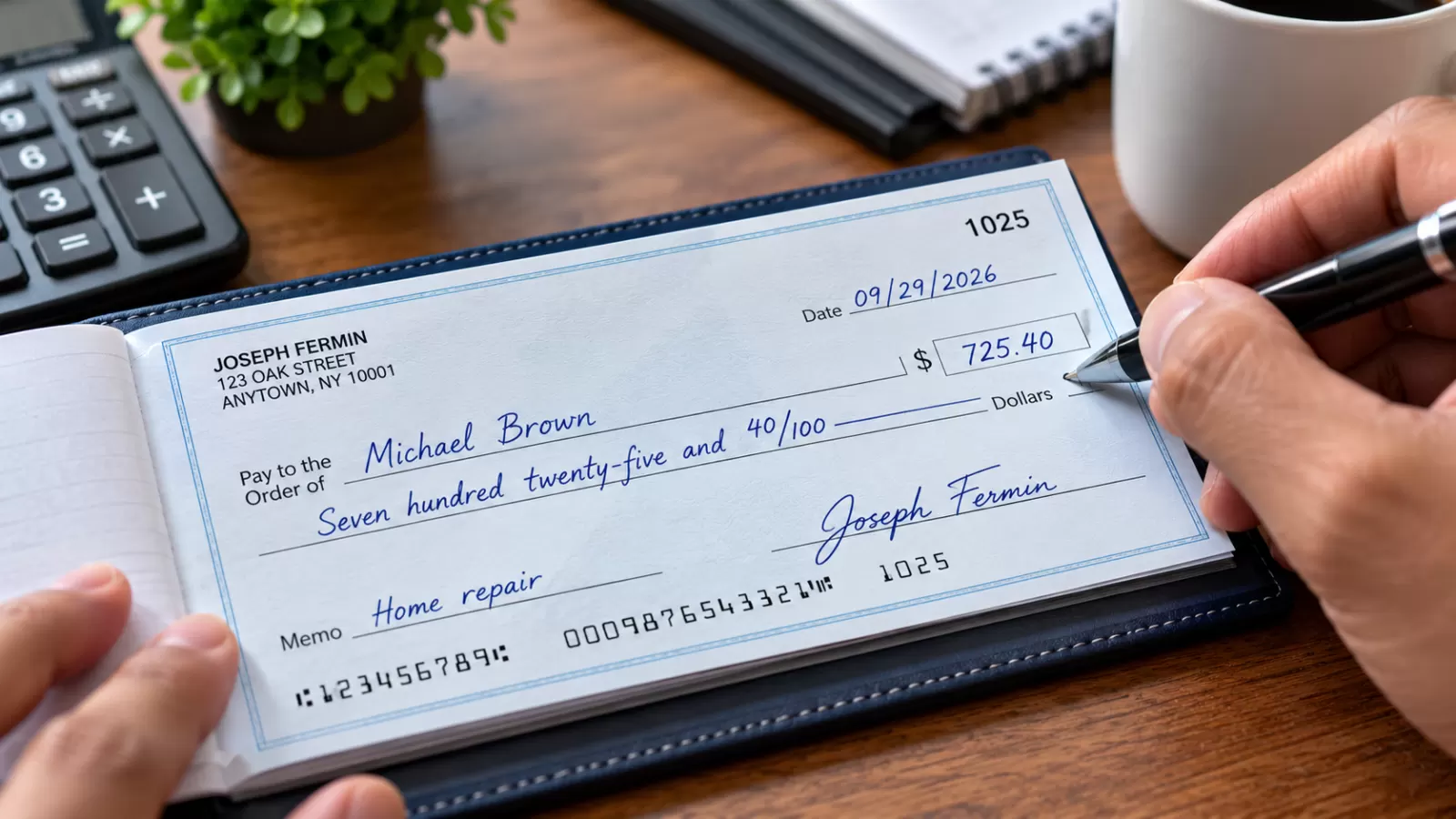
Imagine you’re paying Michael Brown $725.40 for home repairs.
Here’s how the check could look:
Date: September 29, 2026
Pay to the Order of: Michael Brown
Amount box: $725.40
Amount in words: Seven hundred twenty-five and 40/100 dollars
Memo: Home repair
Signature: Your signature
Before giving Michael the check, compare:
$725.40
with:
Seven hundred twenty-five and 40/100 dollars
Both should represent the same amount.
What Are the Numbers at the Bottom of a Check?
You’ll notice several groups of numbers printed along the bottom.
These typically identify things such as the financial institution and account involved in processing the check.
Two terms you’ll commonly encounter are:
Routing Number
A routing number identifies the financial institution involved in a transaction.
Account Number
Your account number identifies your specific bank account.
Because account and routing information can be sensitive, avoid unnecessarily sharing photographs of your checks online.
The Consumer Financial Protection Bureau warns consumers to be careful with bank account and routing information because access to this information can potentially be used in unauthorized transactions or scams. Consumer Financial Protection Bureau
What Is the Check Number?
Personal checks usually have an individual check number.
You might see numbers such as:
101
102
103
and so on.
The number helps you keep track of individual checks.
The FDIC’s check-writing educational material recommends recording the check number and transaction information in your register so you can keep track of your account balance and payments. FDIC
What Is a Check Register?
A check register is a record of transactions involving your checking account.
Traditionally, checkbooks included a small register where you could record:
Check number
Date
Payee
Payment amount
Deposits
Current balance
For example:
| Check | Date | Description | Payment |
|---|---|---|---|
| 101 | Sep. 29 | Michael Brown | $725.40 |
| 102 | Oct. 1 | Electric bill | $96.25 |
| 103 | Oct. 3 | Apartment rent | $1,200.00 |
Even if you primarily use mobile banking, keeping track of outstanding checks remains important.
A check may not leave your account immediately after you hand it to someone.
The CFPB recommends leaving enough money in an account to cover checks that haven’t yet cleared when moving or closing a checking account. Consumer Financial Protection Bureau
How to Write a Check With Cents
Let’s look at another example.
Suppose the check is for:
$86.37
Write:
$86.37
in the numerical box.
On the written line, write:
Eighty-six and 37/100 dollars
The 37/100 represents 37 cents.
Here’s another:
$2,450.09
Write:
Two thousand four hundred fifty and 09/100 dollars
The leading zero makes it clear that the cents amount is nine cents rather than ninety cents.
How to Write a Check for Less Than $1
Suppose you need to write a check for:
$0.75
In the numerical box:
$0.75
On the amount line:
Zero and 75/100 dollars
The same principle applies to other amounts below one dollar.
How to Write a Check to Yourself
You can also write a check payable to yourself.
On the payee line, write your own name.
For example:
Pay to the Order of: John Smith
Complete the amount and other required fields normally, then sign the check.
Whether and how you can deposit or cash it will depend on the financial institutions involved and their policies.
How to Void a Check
Sometimes an employer, payment provider or other organization may request a voided check to verify checking-account information.
To void a blank check, people commonly write:
VOID
clearly across the front.
Do not sign it or fill it out as though you were making a payment unless specifically instructed by your financial institution or the organization requesting it.
And because the check still displays banking information, handle a voided check carefully.
What Happens if You Make a Mistake?
If you’ve made a significant mistake while writing a check and haven’t given it to anyone yet, the safest practical approach is usually to void that check and write a new one.
Write:
VOID
across the incorrect check and keep or destroy it appropriately according to your bank’s recommendations.
Don’t attempt to hide major alterations.
If the incorrect check has already been given to someone, contact the recipient and your financial institution promptly.
Can You Cancel a Check After Writing It?
Potentially.
If a check hasn’t yet been paid, you may be able to request a stop payment through your bank.
The OCC says banks generally honor properly submitted stop-payment requests, but customers need to provide enough information and sufficient notice for the bank to identify and stop the check. Written stop-payment orders commonly expire after six months, although policies can vary. HelpWithMyBank.gov
Your bank may also charge a fee.
Contact your financial institution immediately if you need to stop a check.
What if a Check Is Lost or Stolen?
Contact your bank or credit union as quickly as possible.
Provide whatever information you have, such as:
Check number
Amount
Payee
Date
If you discover an unauthorized check on your account, the CFPB recommends contacting your bank or credit union promptly. The protections that apply can depend partly on how the payment was processed. Consumer Financial Protection Bureau
Regularly reviewing your account activity can help you spot unexpected transactions.
Can a Bank Cash a Check Anywhere?
Not necessarily.
A bank or credit union generally isn’t required to cash every check presented to it.
According to the CFPB, institutions may consider factors such as whether the check was written by one of their account holders, whether sufficient funds are available, the age of the check, the identity of the payee and identification requirements. Fees may also apply for noncustomers. Consumer Financial Protection Bureau
Policies vary, so check with the institution involved.
Does a Check Clear Immediately?
Not necessarily.
There can be a delay between writing a check and seeing the money leave your account.
That’s one reason you should keep enough money available to cover outstanding checks.
You shouldn’t assume that because your current online balance still includes the money, the check won’t be processed later.
Some checks can also be converted into electronic transactions. The CFPB notes that your bank statement may indicate when a check has been processed as an electronic transfer such as an ACH payment. Consumer Financial Protection Bureau
Common Mistakes When Writing a Check
One of the easiest ways to avoid problems is to review the check before handing it over.
Common mistakes include:
Forgetting to sign the check.
Writing the wrong payee.
Writing different numerical and written amounts.
Forgetting the date.
Writing an incorrect amount.
Leaving excessive blank space on the amount line.
Using a postdated check and assuming it cannot be processed early.
Failing to keep enough money in the account to cover the check.
If your bank processes a check for the wrong amount, contact it promptly. The OCC specifically advises customers to notify their bank as soon as possible about check-processing or alteration errors. HelpWithMyBank.gov
How to Write Dollar Amounts Correctly
Here are some examples worth bookmarking:
| Amount | Written Amount |
|---|---|
| $25.00 | Twenty-five and 00/100 dollars |
| $50.25 | Fifty and 25/100 dollars |
| $100.00 | One hundred and 00/100 dollars |
| $125.50 | One hundred twenty-five and 50/100 dollars |
| $500.00 | Five hundred and 00/100 dollars |
| $1,000.00 | One thousand and 00/100 dollars |
| $1,250.75 | One thousand two hundred fifty and 75/100 dollars |
| $5,000.00 | Five thousand and 00/100 dollars |
If you’re working with percentages—for example, determining a deposit, discount or percentage of a payment—BriefTop’s How to Calculate Percentage guide provides the formulas and examples you need.
Should You Use a Pen?
For paper checks, use permanent ink rather than something easily erased.
Write clearly and avoid leaving unnecessary blank spaces.
Before handing over a check, verify:
Payee
Date
Numerical amount
Written amount
Signature
A few seconds of checking can prevent a much larger headache later.
Frequently Asked Questions
How do you write a check step by step?
Write the date, recipient’s name, numerical dollar amount, amount in words, optional memo and your signature.
How do you write $100 on a check?
Write:
$100.00
in the amount box and:
One hundred and 00/100 dollars
on the written amount line.
How do you write $1,500 on a check?
Write:
$1,500.00
and:
One thousand five hundred and 00/100 dollars
How do you write cents on a check?
Write cents as part of the numerical amount and as a fraction over 100 on the written line.
For $75.25:
Seventy-five and 25/100 dollars
Do you have to write a memo on a check?
The memo is generally used as a reference describing the payment. Whether additional information is required can depend on the recipient or purpose of the payment.
What happens if you forget to sign a check?
A signature is a key authorization element of a personal check. If you realize you’ve issued an unsigned check, contact the recipient or your bank for guidance rather than assuming it will process normally.
Can a postdated check be cashed early?
Potentially, yes. The OCC says a bank may generally pay a postdated check before its written date unless appropriate advance notice has been provided to the bank under applicable rules. HelpWithMyBank.gov
Can you stop payment on a check?
Generally, you can ask your bank to stop payment on an eligible personal check that hasn’t already been paid. Timing, fees and requirements vary, so contact your bank promptly. HelpWithMyBank.gov
Final Thoughts
Learning how to write a check is easier than it first appears.
Remember these six steps:
1. Date the check.
2. Write the recipient’s name.
3. Enter the amount numerically.
4. Write the amount in words.
5. Add a memo when useful.
6. Sign the check.
Most importantly, check the information before giving the check to the recipient and make sure your checking account has enough funds available to cover it.
Although digital payments are common, the CFPB still recognizes writing checks as one of the ways consumers can spend money from a checking account.