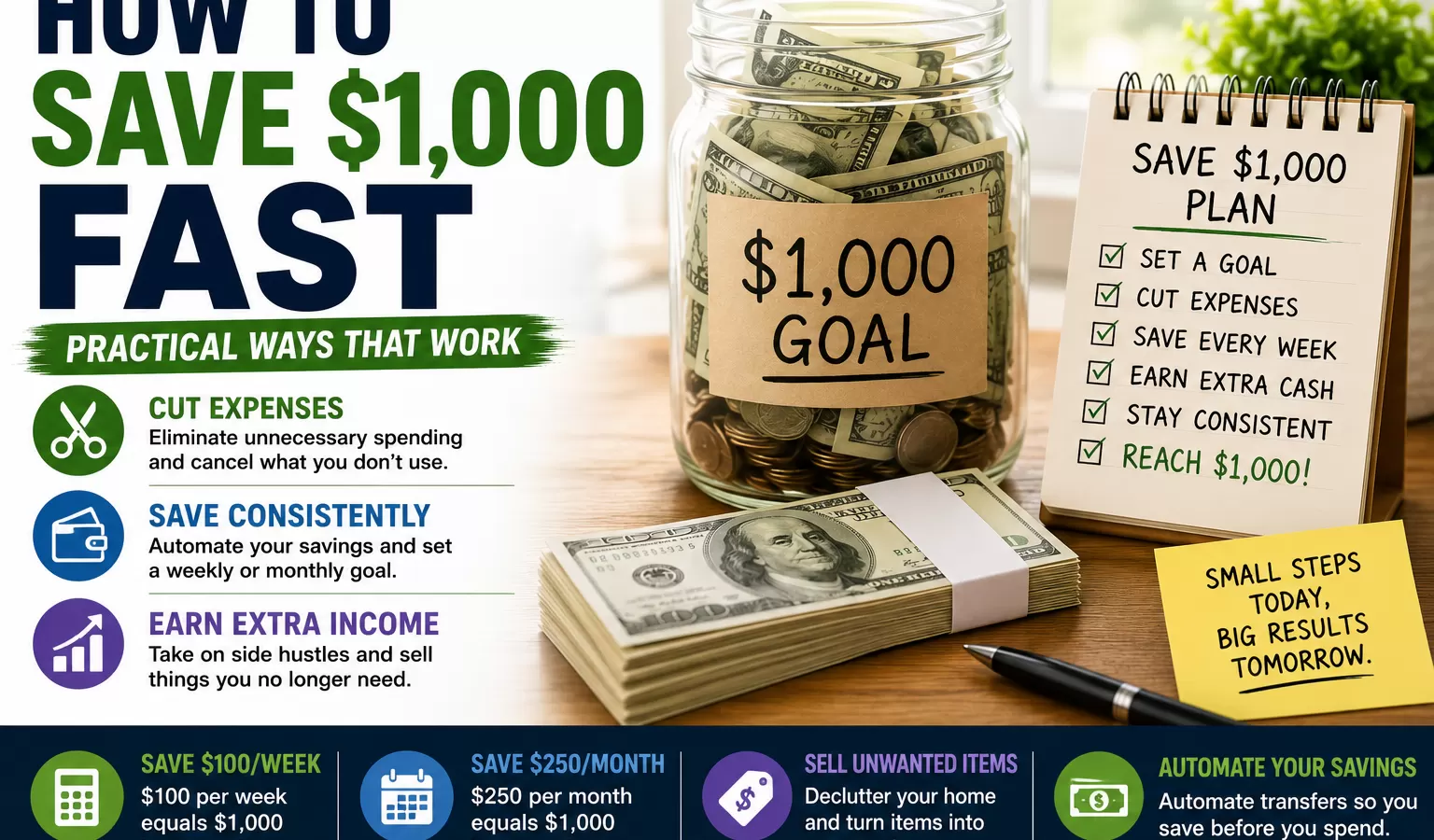
Saving your first $1,000 can feel difficult.
When rent, groceries, transportation, utilities and other bills consume most of your paycheck, finding an extra thousand dollars may seem almost impossible.
But you don’t necessarily need to find $1,000 all at once.
You need a plan for accumulating it.
That could mean:
$250 per month for four months.
Or:
$100 per week for 10 weeks.
Or a combination of spending cuts, automatic savings and additional income.
The best strategy depends on your income and expenses.
Here’s a realistic step-by-step approach to saving $1,000 as quickly as your financial situation allows.
How Long Does It Take to Save $1,000?
Start by choosing a realistic deadline.
Here’s approximately how much you’ll need to save:
| Goal | Monthly/Weekly Target |
|---|---|
| 30 days | $1,000/month |
| 2 months | $500/month |
| 3 months | $334/month |
| 4 months | $250/month |
| 5 months | $200/month |
| 6 months | about $167/month |
| 10 weeks | $100/week |
| 20 weeks | $50/week |
| 40 weeks | $25/week |
There’s nothing magical about reaching the goal in 30 days.
If saving $1,000 in one month would cause you to miss necessary bills, choose a longer timeline.
A sustainable plan is better than an impressive deadline you can’t afford.
Step 1: Decide Why You Want $1,000
Give the money a purpose.
Perhaps you’re building:
- Your first emergency fund
- A car-repair cushion
- A moving fund
- A travel fund
- A buffer between paychecks
- Savings for an upcoming purchase
A specific purpose makes the goal more meaningful.
If you’re building emergency savings, $1,000 can be an excellent first milestone before working toward a larger reserve.
BriefTop’s Emergency Fund: How Much Should You Have? explains how to calculate a longer-term emergency savings target.
Step 2: Choose Your Deadline
Now choose when you want to reach $1,000.
Suppose you choose:
Four months
Your calculation is:
$1,000 ÷ 4 = $250 per month
If you’re paid twice per month:
$250 ÷ 2 = $125 per paycheck
Suddenly, you’re no longer trying to “find $1,000.”
You’re trying to find $125 from each paycheck.
That makes the goal easier to plan around.
Step 3: Look at Your Current Spending
Before cutting expenses randomly, find out where your money is actually going.
Review the previous 30–90 days of transactions.
Look specifically at:
- Restaurants
- Food delivery
- Subscriptions
- Shopping
- Entertainment
- Convenience purchases
- Banking fees
- Transportation
- Groceries
You may discover that several relatively small categories combine into a significant amount.
For example:
Food delivery: $160/month
Unused subscriptions: $45/month
Impulse shopping: $120/month
Convenience purchases: $75/month
Total:
$400 per month
You don’t necessarily need to eliminate all $400.
But reducing those categories could create much of the money required for your savings target.
If you don’t currently track your spending, use BriefTop’s How to Make a Budget guide first.
Step 4: Cut One Large Expense Before Ten Tiny Ones
People often associate saving with giving up small purchases.
Small expenses matter.
But larger expenses can produce faster results.
Suppose you reduce restaurant and delivery spending by:
$150 per month
Cancel $40 of unused subscriptions.
Reduce shopping by:
$75
And lower another recurring bill by:
$35
You’ve created:
$300 per month
At that pace, you could reach $1,000 in a little over three months without needing to eliminate every enjoyable purchase.
Start with the expenses that produce the largest realistic savings.
Step 5: Cancel Unused Subscriptions
Check your bank and credit-card statements for recurring charges.
Look for:
- Streaming platforms
- Apps
- Gaming subscriptions
- Premium memberships
- Cloud storage
- Software
- Fitness memberships
- Other recurring services
Suppose you cancel:
$15 streaming service
$12 app
$20 membership
$10 cloud/software service
Total:
$57 per month
Over four months:
$57 × 4 = $228
That’s more than one-fifth of your $1,000 goal.
Step 6: Temporarily Reduce Restaurant Spending
You don’t have to swear off restaurants forever.
Treat the $1,000 goal as a temporary challenge.
Suppose you normally spend:
$350 per month
on restaurants, takeout and delivery.
Reduce that to:
$175
Savings:
$175 per month
Over four months:
$700
That change alone gets you most of the way to $1,000.
Step 7: Use a 24-Hour Purchase Rule
For the duration of your savings challenge, wait before making nonessential purchases.
When you want something, add it to a list instead of immediately buying it.
Wait at least 24 hours.
For more expensive purchases, wait several days.
You may discover that the desire disappears.
Every purchase you decide not to make can be transferred toward your $1,000 target.
Step 8: Automate the Money
Don’t rely entirely on willpower.
If your goal is $50 per week, consider automatically transferring $50 into a dedicated savings account each week.
The Consumer Financial Protection Bureau recommends automatic recurring transfers as one method for making savings contributions consistent.
The idea is simple:
Save before the money gets absorbed into everyday spending.
Learn more about building savings from the Consumer Financial Protection Bureau
Step 9: Save Unexpected Money
Unexpected income can dramatically shorten your timeline.
Consider putting some or all of these toward your $1,000 goal:
- Tax refund
- Work bonus
- Overtime
- Gift money
- Cash-back rewards
- Refunds
- Freelance income
- Money from selling belongings
Suppose you’re already at:
$425
Then you receive a:
$300 bonus
If you save it, your balance immediately becomes:
$725
Now you only need another:
$275
Step 10: Sell Things You Don’t Use
Look around your home.
You may have money sitting in closets, drawers or storage.
Potential items include:
- Old smartphones
- Electronics
- Furniture
- Video games
- Clothing
- Tools
- Sports equipment
- Collectibles
- Small appliances
Suppose you sell:
Old phone: $150
Unused chair: $75
Clothing: $60
Video games: $40
Total:
$325
You’ve completed almost one-third of the challenge without changing your paycheck.
Step 11: Find Temporary Extra Income
There’s a limit to how much you can cut from a budget.
If your necessary expenses already consume most of your income, earning additional money may be more effective.
Depending on your skills and circumstances, possibilities could include:
- Overtime
- Freelance projects
- Part-time work
- Pet sitting
- Tutoring
- Yard work
- Cleaning
- Selling a service
- Seasonal work
Be realistic about expenses, taxes and time involved with additional work.
The objective is to increase the amount available for your goal, not simply become busier without actually keeping more money.
A Realistic $1,000 Savings Plan
Here’s one example.
Month 1
Automatic savings: $150
Canceled subscriptions: $50
Reduced restaurants: $100
Sold unused items: $150
Month 1 total: $450
Month 2
Automatic savings: $150
Reduced restaurants: $100
Reduced shopping: $50
Month 2 total: $300
Running total:
$750
Month 3
Automatic savings: $150
Reduced restaurants: $100
Month 3 total: $250
Final total:
$1,000
Goal reached.
Notice that no single strategy produced the entire amount.
Several manageable changes worked together.
How to Save $1,000 in 30 Days
Saving $1,000 in one month requires finding approximately:
$250 per week
or roughly:
$33 per day over 30 days
For many households, cutting expenses alone won’t create $1,000 in one month.
A 30-day strategy may require combining:
Expense reductions: $300
Selling unused belongings: $300
Additional income: $300
Existing available cash: $100
Total:
$1,000
Don’t force yourself into financial hardship simply to meet an arbitrary 30-day deadline.
If necessary, use 60 or 90 days.
How to Save $1,000 in 3 Months
Three months is a more manageable target for many people.
You need approximately:
$334 per month
One possible plan:
Automatic savings: $150/month
Restaurant reduction: $75/month
Shopping reduction: $50/month
Subscriptions: $25/month
Additional income: $35/month
Total:
$335 per month
Over three months:
$1,005
Goal achieved.
How to Save $1,000 in 6 Months
A six-month target requires approximately:
$167 per month
That’s around:
$39 per week
A possible approach:
Subscriptions: $25/month
Restaurants: $50/month
Automatic savings: $75/month
Additional savings: $20/month
Total:
$170 per month
After six months:
$1,020
The $20-a-Week Challenge
If your budget is tight, start smaller.
Saving:
$20 per week
for 50 weeks equals:
$1,000
It takes longer, but you still reach exactly the same destination.
The speed of your progress doesn’t determine whether the goal is worthwhile.
What If You Have a Low Income?
Saving $1,000 can be much harder when most of your income already goes toward necessities.
Don’t compare your timeline with someone who has significantly more disposable income.
If you can save:
$10/week → $520/year
$15/week → $780/year
$20/week → $1,040/year
Small amounts can still produce meaningful savings when repeated consistently.
If essential expenses consume your entire income, however, the solution may require more than simply cutting discretionary purchases.
Available assistance programs, increased income or changes to major expenses may be more important.
If most of your paycheck already goes toward necessities, start with our guide on how to stop living paycheck to paycheck before setting an aggressive savings deadline.
Where Should You Keep the $1,000?
If the money is intended as emergency savings, consider keeping it somewhere that is:
Safe
Accessible
Separate from everyday spending
A dedicated savings account at an appropriate bank or credit union can be one option.
The CFPB notes that a dedicated bank or credit-union account can be a useful place for emergency savings.
What Should You Do After Reaching $1,000?
Celebrate the milestone — but don’t automatically spend the money.
Decide what the $1,000 represents.
If it’s your starter emergency fund, your next goal could be:
One month of essential expenses
Then:
Three months
And potentially:
Six months
depending on your circumstances.
If $1,000 was for another financial goal, establish your next target.
The important part is preserving the savings habit you just created.
How Much Should You Keep Saving Each Month?
Once you’ve proven that you can save consistently, decide on a long-term monthly amount.
Perhaps you saved $250 each month to reach $1,000.
Can you continue saving:
$250 per month?
If yes:
$250 × 12 = $3,000 per year
Your $1,000 challenge can become the beginning of a much larger financial habit.
BriefTop’s How Much Should I Save Each Month? can help you choose a sustainable percentage based on your income.
Frequently Asked Questions
How fast can I realistically save $1,000?
It depends on your income, expenses and available savings opportunities. At $250 per month, it takes four months. At $100 per week, it takes 10 weeks. Choose a timeline that doesn’t interfere with essential expenses.
How much do I need to save weekly to reach $1,000?
Saving $100 per week takes 10 weeks. $50 per week takes 20 weeks. $25 per week takes 40 weeks. $20 per week takes 50 weeks.
Can I save $1,000 in one month?
Yes, if your income and expenses leave enough room or you’re able to combine savings with additional income or selling unused items. It isn’t realistic for every household.
Is $1,000 a good emergency fund?
$1,000 can be a useful starter emergency fund, but it may not cover a major income disruption. Consider it an initial milestone and continue building based on your essential monthly expenses.
Should I pay debt or save $1,000 first?
The appropriate strategy depends on your debt costs, income stability and financial circumstances. Having some emergency savings can help prevent unexpected expenses from creating new debt, while expensive debt may also require priority.
The Bottom Line
Learning how to save $1,000 fast isn’t about finding a secret financial trick.
Break $1,000 into smaller targets.
Cut several expenses instead of relying on one dramatic sacrifice.
Automate part of the savings.
Use unexpected money strategically.
Sell things you don’t need.
Increase income when possible.
Then track your progress.
Whether reaching $1,000 takes 30 days, three months or a year isn’t the most important part.
The important part is reaching it without creating another financial problem along the way.
And once you reach your first $1,000:
keep going.
The habits that helped you save the first $1,000 can help you build the next $1,000 too.
Editorial Note: This article provides general educational information and does not constitute individualized financial, investment, tax or legal advice.
Trusted Sources
Consumer Financial Protection Bureau (CFPB): Consumer guidance about building emergency savings and creating consistent savings habits.
BriefTop: How Much Should I Save Each Month?, How to Save Money Fast, Emergency Fund and How to Make a Budget.